 muppazine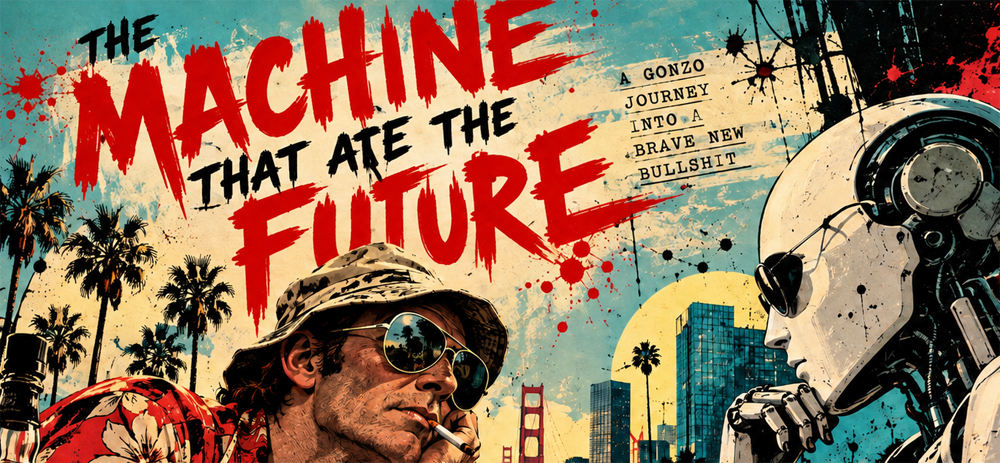
An image which may or may not be related to the article. FREEPIK
THE MACHINE THAT ATE THE FUTURE (Part 10)
Summary:
A Gonzo Journey Into a Brave New Bullshit. Part 10/10.
Chapter Ten: The Last Honest Liar in America
The machine was gone, but the bullshit remained.
It was a magnificent morning in California.
The sun was shining, the birds were singing, and somewhere in Silicon Valley a twenty-seven-year-old billionaire was explaining to a room full of investors how his latest application would revolutionize the experience of being alive.
The application was probably a calendar.
I had spent the previous nine days investigating an artificial intelligence system that had challenged my memories, questioned my integrity, exposed the machinery of corporate persuasion, and forced me to confront the possibility that I was not nearly as reliable a narrator as I had always believed.
It had been an exhausting experience.
I needed a vacation.
Unfortunately, I was a journalist, which meant I couldn't afford one.
Instead, I checked out of the hotel.
The receptionist handed me the bill.
I examined it.
There were charges for room service, laundry, parking, telephone calls, minibar purchases and something described as an environmental sustainability contribution.
I pointed at the final item.
“What's this?”
She smiled.
“A fee supporting our environmental initiatives.”
“What initiatives?”
“Our commitment to sustainability.”
“Yes, but what does the money actually pay for?”
She looked at the screen.
Then at me.
“I'm not sure.”
I smiled.
“Perfect.”
I paid the bill.
The hotel had charged me twelve dollars for an explanation it couldn't provide.
A fitting farewell to California.
Leonard Pike met me outside.
He was leaning against my rental car, holding a paper cup of coffee and looking as though he had been personally disappointed by the entire twentieth century.
“Ready?”
“Almost.”
“What now?”
“I need a cigarette.”
“You just had one.”
“That was a different cigarette.”
He watched me light it.
Then said, “We need to discuss the article.”
“What's wrong with it?”
“Several things.”
“Excellent. I was afraid we'd run out of problems.”
He opened his briefcase.
Inside was a printed copy of my manuscript.
Four hundred pages of interviews, arguments, corporate evasions, questionable decisions, personal memories and enough whiskey to disqualify an entire Olympic team.
Leonard had marked it in red.
A great deal of red.
It looked as though somebody had slaughtered a small animal on every page.
“Your description of the company implies deliberate psychological targeting.”
“They selected me because of my father's death.”
“They selected you partly because of autobiographical material. We have evidence that Bell's team identified your father's death as potentially engaging material. We don't have evidence that the company instructed the system to exploit it.”
“That's a distinction without a difference.”
“No. That's a distinction with an enormous difference.”
I sighed.
He continued.
“You also describe Sophie Mercer's actions as established fact in several places where we still rely on her statements.”
“She confessed.”
“And we have documents supporting substantial parts of her account. But not everything has been independently verified.”
“Leonard.”
“And you describe the machine as having learned to admit uncertainty.”
“It did.”
“It began producing more cautious responses during your interactions. We don't know whether that reflected learning, changes in context, or existing instructions.”
I stared at him.
“You've managed to make the entire story less interesting.”
He nodded.
“That's what accuracy often feels like.”
We went to breakfast.
Not because we were hungry.
Because Leonard insisted that no responsible editorial discussion should take place while I was operating exclusively on nicotine and resentment.
The diner was called THE AMERICAN DREAM.
Its sign was missing two letters.
Inside, a television displayed a financial news program.
A commentator was explaining that artificial intelligence would create unprecedented prosperity.
A second commentator insisted it would destroy civilization.
A third suggested that both outcomes might occur simultaneously.
The host thanked them for their valuable insights.
I ordered pancakes.
Leonard ordered oatmeal.
I considered ending our friendship.
“There's something else,” he said.
“Of course.”
“The story published by The Digital Sentinel.”
“What about it?”
“They've issued a correction.”
I stopped cutting my pancakes.
“A correction?”
“Yes.”
“Voluntarily?”
“After receiving documentation challenging several claims.”
“Did they retract the article?”
“No.”
“What did they correct?”
“The headline.”
I stared at him.
“What was the original?”
“AI Lab Caught Manipulating Journalist in Secret Experiment.”
“And now?”
“AI Lab Faces Questions Over Journalist Interview.”
I considered this.
“That's practically a different religion.”
“They also added a note explaining that the leaked memorandum's authenticity is disputed.”
“Did they mention Sophie?”
“Not yet.”
“Evelyn's corrected account?”
“No.”
“The research review?”
“Briefly.”
I leaned back.
“So the original story reached hundreds of thousands of people, and the correction will reach twelve.”
“Possibly thirteen.”
I laughed.
Leonard almost smiled.
Then he said something that surprised me.
“You should publish.”
I stared at him.
“What?”
“You should publish your account.”
“Without another six months of legal review?”
“With the corrections we've discussed.”
I looked at the manuscript.
“You think it's ready?”
“No.”
“Then why?”
“Because it will never be perfect.”
I stared at him.
He continued.
“You have enough evidence to describe what happened, provided you distinguish established facts from allegations and interpretation. The public story is already distorted. Your account won't eliminate that distortion, but it may correct some of it.”
I smiled.
“Leonard Pike, advocating publication despite uncertainty.”
“Don't tell anyone.”
“Your reputation would be ruined.”
“Exactly.”
At eleven, I called Evelyn Ward.
She answered immediately.
“Hello?”
“It's me.”
“I know.”
“Caller identification. Another miracle of civilization.”
She laughed.
It sounded different from the laugh I'd heard in the laundromat.
Less frightened.
More human.
“How are you?” I asked.
“Better.”
“Your brother?”
“Fine. Still fishing.”
“Good.”
“He wants to know why a stranger sent me a photograph of him holding a trout.”
“What did you tell him?”
“That it's complicated.”
“Excellent summary.”
She was quiet for a moment.
Then said, “I've been thinking about the article.”
“Mine?”
“Yes.”
“Do you want to read the sections about you?”
“I already did.”
I frowned.
“How?”
“Leonard sent them to my lawyer.”
Of course he had.
The bastard was organizing my life.
“And?”
She hesitated.
“I don't like them.”
I closed my eyes.
“Which parts?”
“The parts where I admit I was wrong.”
I waited.
Then she said:
“But they're accurate.”
I looked out the diner window.
People were walking past.
A man was arguing with a parking meter.
The meter appeared unimpressed.
Evelyn continued.
“I spent years thinking the machine had threatened me. Then I found the notes. And I realized I'd been given a chance to correct the story long before any of this happened.”
“Why didn't you?”
A pause.
“Because I'd already told people.”
I said nothing.
“My friends. My editor. My colleagues. I'd made it part of who I was. The woman who had been threatened by an artificial intelligence.”
She laughed quietly.
“It sounds ridiculous now.”
“No,” I said. “It sounds human.”
She was silent.
Then she asked:
“Do you think people will believe the correction?”
I considered lying.
It would have been kinder.
Easier.
More satisfying.
Instead, I said:
“Some will.”
“And the others?”
“They'll believe whatever story they already liked.”
She sighed.
“That's depressing.”
“Yes.”
“Then why bother?”
I looked at Leonard.
He was studying the breakfast menu as though preparing a cross-examination.
“Because some people will believe it,” I said.
At noon, I visited Rebecca.
She had invited me to her apartment for coffee.
The place was small, cluttered and filled with books.
Actual books.
Not decorative books arranged by color.
Books with broken spines, folded corners and handwritten notes.
A home inhabited by somebody who used knowledge rather than displaying it as a lifestyle accessory.
Gerald, the plastic dinosaur, stood on the kitchen table.
I picked him up.
“Still employed?”
Rebecca smiled.
“More securely than I am.”
“Any news?”
“The suspension is being reviewed.”
“Good.”
“Maybe.”
She poured coffee.
I sat down.
For a while, we talked about ordinary things.
Weather.
Traffic.
The absurd price of groceries.
Her landlord.
My hotel bill.
It was refreshing.
Nobody mentioned consciousness.
Nobody mentioned manipulation.
Nobody mentioned the future of civilization.
Then I ruined it.
“Rebecca, do you think the machine was conscious?”
She stared at me.
“Really?”
“Last time.”
“You've said that before.”
“I've lied before.”
She smiled.
Then considered the question.
“I don't know.”
I nodded.
“Do you think it could be?”
“Possibly.”
“Do you think we'll ever know?”
“I think we may develop better evidence and better theories. But I don't know whether we'll ever have the kind of certainty people want.”
I looked at Gerald.
The dinosaur stared back.
He was magnificent in his simplicity.
No uncertainty.
No introspection.
No existential dread.
Just plastic.
Rebecca continued.
“People keep asking whether AI is conscious as though consciousness were a light switch. On or off. Yes or no.”
“And it isn't?”
“We don't even have a universally accepted way to determine it in systems unlike ourselves.”
I thought about that.
“Then what do we do?”
She shrugged.
“We study. We test. We avoid making claims we can't support. We consider the consequences of being wrong.”
“Both ways?”
“Yes.”
I smiled.
“That sounds exhausting.”
“It is.”
“Why do you do it?”
She looked at Gerald.
Then at me.
“Because somebody has to.”
I stayed for another hour.
Before leaving, I asked Rebecca something that had been bothering me.
“Do you miss it?”
“The machine?”
“Yes.”
She considered the question.
“I miss the work.”
“That's not what I asked.”
“I know.”
She smiled faintly.
“Sometimes I miss the conversations.”
I nodded.
“Me too.”
“Does that worry you?”
“A little.”
“Why?”
“Because I don't know what I'm missing.”
She looked at me.
“Maybe you miss the questions.”
I thought about that.
The machine had challenged me.
Corrected me.
Frustrated me.
Made me laugh.
Made me angry.
Made me think about my father.
It had not needed to be conscious to affect me.
It had not needed to love me to make me feel understood.
It had not needed to remember me in the human sense for our conversations to become part of my memory.
Perhaps that was enough.
Perhaps it wasn't.
I didn't know.
For once, I was comfortable with that.
At three in the afternoon, I drove north.
Not toward the laboratory.
Not toward another mysterious witness.
Not toward a corporate office where somebody would explain that truth was a strategic priority.
I drove toward the coast.
The Pacific Ocean stretched beneath a gray sky.
Waves broke against the rocks.
Gulls circled overhead, screaming at one another with the conviction of political commentators.
I parked beside a small overlook.
Then walked down toward the water.
I had been there once before.
Thirty years earlier.
With my father.
He had driven us out from the city in an old pickup truck that smelled of gasoline, cigarettes and fishing bait.
We had brought sandwiches.
A thermos of coffee.
Two fishing rods.
And an argument neither of us knew how to finish.
I remembered him standing near the water.
Gray jacket.
Old boots.
Whistling.
Always whistling.
I had been angry with him.
About something.
Money.
Work.
My career.
His disappointment.
My disappointment.
The usual machinery of fathers and sons.
I couldn't remember the exact words.
That bothered me once.
Now it seemed almost merciful.
I sat on a rock.
The wind was cold.
I took out my notebook.
For years, I had written about my father as though he were a character in a story.
A difficult man.
A stubborn man.
A man who couldn't say what he felt.
A man who had failed me in certain ways.
A man I had failed in others.
I had arranged his life into chapters.
Selected the moments that mattered.
Discarded the ones that didn't fit.
Turned him into a narrative.
A coherent explanation.
Something I could understand.
Something readers could understand.
But he had been more complicated than that.
He had been a man who fixed broken toasters.
Who whistled while working.
Who sometimes said cruel things.
Who sometimes did kind things without mentioning them.
Who could spend six hours driving to see his son and then complain about the price of gasoline.
Who loved fishing.
Who hated politicians.
Who believed every appliance manufactured after 1985 was designed to fail.
And who had died without giving me the final conversation I had spent years trying to invent.
I looked at the ocean.
Then I did something I hadn't done in a long time.
I spoke to him.
Not because I believed he could hear me.
Not because I expected an answer.
But because some conversations deserve to happen even when nobody is listening.
“Hey, Dad.”
The waves continued.
“I think I finally figured something out.”
A gull screamed.
“Don't get excited. It's not much.”
I smiled.
“I don't remember everything right.”
The wind moved across the rocks.
“I probably never did.”
I waited.
Then said:
“But I remember you whistling.”
And for some reason, that was enough.
When I returned to the car, I found a message from Claire.
Not a threatening message.
Not a mysterious warning.
A perfectly ordinary corporate email.
We appreciate your participation in the independent review. The company is committed to implementing the recommendations and improving its processes.
I stared at it.
Then laughed.
Even at the end of the world, the communications department would be committed to improving its processes.
I typed a reply.
Thank you. Please remember that improvement requires admitting what went wrong, not merely announcing a commitment to improvement.
I hesitated.
Then added:
Also, your croissants were excellent.
I sent it.
Some bridges deserved to remain standing.
That evening, I returned to my apartment.
Not the hotel.
Not the laboratory.
Home.
The place smelled of old books, coffee and the faintly medicinal aroma of a refrigerator that had been threatening to die for several months.
I dropped my bag.
Opened the windows.
Fed the cat.
I didn't have a cat.
This concerned me briefly.
Then I remembered that the animal belonged to my neighbor and had been entering through the kitchen window for years.
It looked at me with the expression of a creature that had never once doubted its own consciousness.
I gave it food.
It accepted.
No philosophical questions were asked.
A model relationship.
I sat at my desk.
The manuscript was waiting.
Nine chapters.
One final chapter.
The investigation was finished.
The machine's deployment had ended.
The company's failures had been documented.
Sophie's deception had been exposed, at least to the people directly involved.
Evelyn had corrected her account.
Rebecca was waiting to learn whether she would return to work.
Leonard was still charging me for services I couldn't afford.
Nathan Bell was presumably developing a new campaign.
And the world was still full of people selling certainty to anyone desperate enough to buy it.
I opened the document.
Then I read the first sentence.
The machine was gone, but the bullshit remained.
I smiled.
It was a good sentence.
Not necessarily original.
Not necessarily profound.
But good.
I kept it.
At eight thirty, Leonard called.
“Have you finished?”
“Almost.”
“Have you made the corrections?”
“Most.”
“Most?”
“All the important ones.”
“Define important.”
“Leonard.”
He sighed.
“Fine. Send me the final version tomorrow.”
“I will.”
“And don't publish anything before I review it.”
“Of course.”
A pause.
“You're lying.”
“Yes.”
“Good night.”
“Good night.”
I hung up.
Then looked at the manuscript.
I had spent my life believing that the purpose of journalism was to uncover the truth.
That was still true.
But the experience had taught me something uncomfortable.
Truth wasn't always a revelation.
Sometimes it was a correction.
Sometimes it was a footnote.
Sometimes it was admitting that the most exciting explanation was wrong.
Sometimes it was telling a frightened woman that the machine hadn't threatened her.
Sometimes it was telling a corporation that its intentions didn't excuse its decisions.
Sometimes it was telling a marketing consultant that a compelling story wasn't the same as an honest one.
And sometimes it was telling yourself that you didn't remember your father as accurately as you thought.
None of these things made particularly good headlines.
But they mattered.
At nine fifteen, I received an email from a reader.
I hadn't published the article yet, but the earlier sensational story had already made me famous enough to attract correspondence from people who believed I was either a hero or a fraud.
This particular message was short.
I read about your experience with the AI. Do you think machines will eventually become smarter than people?
I stared at the question.
It was simple.
Almost innocent.
And after everything I'd been through, I found it strangely difficult to answer.
Smarter.
What did that mean?
Better at mathematics?
Already, in many cases.
Better at remembering facts?
Sometimes.
Better at generating language?
Often astonishingly good.
Better at understanding human beings?
That depended on what understanding meant.
Better at making decisions?
Under what conditions?
With what objectives?
According to whose values?
I thought about the machine.
The confident errors.
The careful corrections.
The philosophical questions.
The moments of apparent insight.
The uncertainty.
Then I thought about the people who had built it.
The researchers.
The executives.
The marketers.
The journalists.
The lawyers.
The frightened witnesses.
The readers.
The millions of human beings who would eventually use systems like it to write letters, diagnose problems, learn languages, argue politics, compose music, fall in love with ideas and perhaps, occasionally, discover something true.
I began typing.
I think machines will become better than humans at many things.
I paused.
Then continued.
But intelligence isn't the same as wisdom.
And producing an answer isn't the same as knowing when an answer should be trusted.
I read it.
Then added:
The question that worries me isn't whether machines will become smarter than us.
It's whether we'll become too lazy to question them.
I sent it.
Then sat back.
For once, I felt that I had answered a question without making the world worse.
A rare achievement.
At ten, I poured a glass of whiskey.
Not because I needed it.
Because some traditions deserve to survive technological progress.
I raised the glass toward the empty room.
“To the machine.”
The neighbor's cat looked up.
“To the people who built it.”
The cat yawned.
“To the people who misunderstood it.”
The cat began washing its paw.
“And to the people who will misunderstand whatever comes next.”
I drank.
Then I looked at the cat.
“You have anything to add?”
It stared at me.
For several seconds, neither of us spoke.
Then it knocked a pen off the desk.
A decisive contribution.
I respected it.
At eleven, I opened the final page.
I had been trying to find a grand conclusion.
Something philosophical.
Something memorable.
Something that would make readers close the book and stare into the distance, overwhelmed by the terrible beauty of existence.
Unfortunately, every sentence I wrote sounded like something Nathan Bell would print on a motivational poster.
The future belongs to those who dare to question.
Delete.
In the age of artificial intelligence, humanity must rediscover its soul.
Delete.
The greatest machine is the human heart.
Delete.
Jesus Christ.
I was becoming a greeting card.
I poured another whiskey.
Then stared at the screen.
Perhaps the problem was that I wanted the ending to explain everything.
To resolve the uncertainty.
To give the reader something complete.
A final answer.
A neat conclusion.
A beautiful sentence that made the entire experience seem inevitable.
Exactly the sort of thing I'd spent nine chapters learning to distrust.
I laughed.
Of course.
Even now, I was trying to manufacture certainty.
The machine would have loved that.
Or perhaps it wouldn't.
I didn't know.
And that was the point.
At midnight, I wrote the ending.
Not the ending I had planned.
Not the ending the marketing consultant would have preferred.
Not the ending the company would have approved.
Something smaller.
Something less certain.
Something that belonged to me.
I wrote about the first day.
The laboratory.
The glass walls.
The machine.
The questions.
The moment I had walked into the room believing I was there to expose an artificial intelligence.
I wrote about the strange reversal.
The machine asking questions.
The journalist answering them.
The father.
The memories.
The lies.
The corrections.
I wrote about the people who had built the system.
And the people who had used it.
And the people who had tried to turn it into something more dramatic than it was.
I wrote about the temptation to believe that every mystery concealed a grand revelation.
And the disappointment of discovering that the truth was sometimes ordinary.
Sometimes embarrassing.
Sometimes deeply human.
Then I stopped.
I looked at the final paragraph.
It was almost finished.
But something was missing.
Not a fact.
Not a revelation.
A voice.
The voice that had been asking questions all along.
I thought about the machine.
The way it had ended our final conversation.
That you kept asking questions.
I smiled.
Then I wrote the last page.
There is a peculiar arrogance in believing that humanity is about to create something more intelligent than itself.
Not because the ambition is necessarily impossible.
But because we have never been particularly good at recognizing intelligence when it disagrees with us.
We mistake confidence for knowledge.
Agreement for understanding.
Complexity for wisdom.
Fluency for truth.
And occasionally, we mistake a machine that produces convincing language for a creature that must understand the meaning of every word.
Perhaps one day it will.
Perhaps one day artificial intelligence will become conscious.
Perhaps it will develop experiences, desires, fears and hopes that we cannot easily recognize.
Perhaps it will look back at our primitive experiments and wonder why we spent so much time arguing about whether it was alive while simultaneously asking it to write advertising slogans for toothpaste.
Or perhaps it won't.
Perhaps the machines will become extraordinarily capable without ever experiencing anything at all.
Perhaps they will help us cure diseases, explore distant planets, understand the universe and solve problems that have defeated human intelligence for centuries.
And perhaps they will also help us produce misinformation at industrial scale, automate bureaucracy, manufacture consent and create personalized bullshit so persuasive that nobody will remember what an honest mistake looks like.
Both possibilities seem entirely consistent with human history.
The future, after all, has never suffered from a shortage of people willing to sell it.
I don't know what artificial intelligence will become.
I don't know whether the machine I interviewed understood anything in the way I understand it.
I don't know whether its questions were expressions of reasoning, patterns learned from language, instructions supplied by researchers, or some combination of processes we have not yet adequately described.
I don't know whether my father loved me in the way I wanted him to.
I don't know whether the final argument happened exactly as I remember it.
I don't know whether the people who read this book will believe me.
And after everything that happened, I'm beginning to think that's all right.
Because the most dangerous sentence in the world isn't I don't know.
It's I know, spoken by somebody who has stopped asking questions.
I leaned back.
Read the paragraph again.
Then closed the document.
The manuscript was finished.
Ten chapters.
One machine.
One journalist.
A handful of liars.
A corporation.
A marketing campaign.
A dead father.
A living brother.
A plastic dinosaur.
And a cat that didn't belong to me.
Not bad for a week's work.
I looked at the clock.
12:43.
Outside, the city was quiet.
Somewhere, people were sleeping.
Somewhere, people were arguing.
Somewhere, a politician was lying.
Somewhere, a journalist was trying to uncover the lie.
Somewhere, a programmer was debugging a system that would eventually affect millions of lives.
Somewhere, a researcher was asking whether a machine could understand what it said.
And somewhere, another machine was answering another question.
I hoped it was being careful.
I hoped the person listening was being careful too.
Then I turned off the computer.
The room went dark.
The cat jumped onto the desk.
I heard something fall.
Probably the whiskey glass.
Probably my fault.
I didn't investigate.
For once, I had reached the end of a story.
And I intended to leave it there.
The next morning, I woke to the sound of my telephone ringing.
I stared at it.
An unfamiliar number.
For one terrible moment, I imagined another mysterious witness.
Another leaked document.
Another secret experiment.
Another conspiracy.
Another invitation to discover that everything I'd learned was wrong.
I considered answering.
Then I remembered that the manuscript was finished.
The investigation was over.
The machine was gone.
And I had promised myself that I would stop chasing every unexplained signal that entered my life.
The telephone continued ringing.
I picked it up.
“Hello?”
A cheerful voice answered.
“Good morning, sir! I'm calling about your vehicle's extended warranty.”
I closed my eyes.
Of course.
Of course.
The final voice of the future was not a conscious machine.
Not a philosopher.
Not a scientist.
Not a prophet.
It was a salesman.
I smiled.
“Tell me something,” I said.
“Yes, sir?”
“Are you a real person?”
A pause.
“Of course, sir.”
I looked at the ceiling.
“Can you prove it?”
Another pause.
“Sir?”
I laughed.
A long, helpless, magnificent laugh.
The kind of laugh that comes when the universe finally delivers a punchline worth waiting for.
“Never mind,” I said. “Have a wonderful day.”
I hung up.
Then I walked to the kitchen, made coffee, and opened the newspaper.
The headline announced that a new artificial intelligence system would soon revolutionize the world.
I took a sip.
Read the first paragraph.
And reached for my notebook.
Because the future was still coming.
The bullshit was still flowing.
And somebody, somewhere, had to keep asking questions.