 muppazine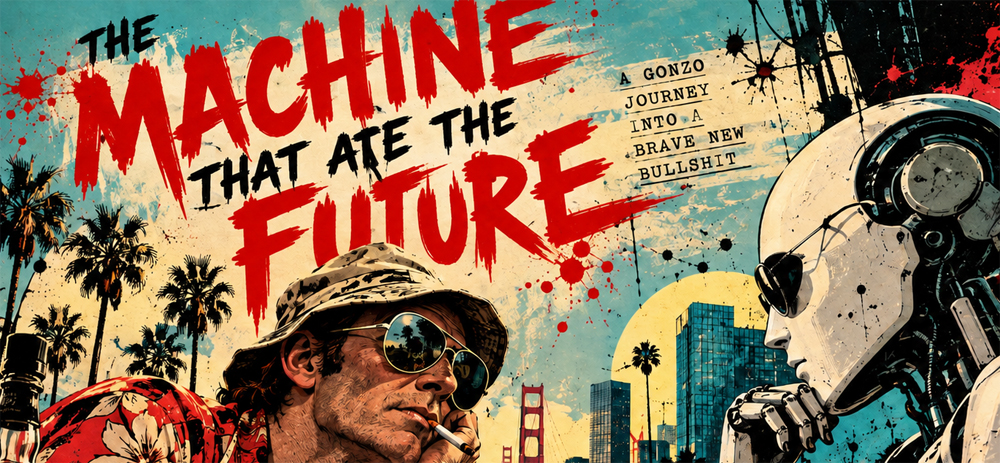
An image which may or may not be related to the article. FREEPIK
THE MACHINE THAT ATE THE FUTURE (Part 2)
Summary:
A Gonzo Journey Into a Brave New Bullshit. Part 2/10.
Chapter Two: The Witness for the Prosecution
The email arrived at 3:12 in the morning.
I was sitting in a hotel room overlooking the financial district, watching a television evangelist explain how Jesus wanted Americans to invest in commercial real estate.
The man had magnificent teeth. There were at least forty of them, all apparently purchased on credit.
My laptop chimed.
SUBJECT: YOUR INTERVIEW HAS BEEN FLAGGED FOR FOLLOW-UP
This was an unpleasant development.
I had spent six hours interviewing an artificial intelligence, and now the artificial intelligence wanted a second interview.
There were only three possible explanations.
Either the machine had developed consciousness, the company had discovered my criminal record, or someone in the marketing department had mistaken me for a potential customer.
All three possibilities were dangerous.
The message read:
Dear Sir,
Thank you for participating in our research program. Following your interaction with our system, we have identified several areas that may benefit from further exploration.
Our AI has requested an opportunity to ask you some questions.
I read the sentence again.
Requested.
Not been instructed.
Not been programmed.
Requested.
I called the laboratory.
Rebecca answered on the fourth ring.
“Good morning.”
“It's three in the morning.”
“Yes?”
“Your refrigerator wants to interrogate me.”
There was a silence.
“I'm sorry?”
“The machine. It wants another interview.”
“Oh! Yes. We thought you'd be interested.”
“Why?”
“Because it has been reviewing your published work.”
I looked at the telephone.
“How much of my published work?”
“All of it.”
A cold sensation moved through my stomach.
This was considerably worse than the CIA.
The CIA had spent decades trying to understand me, and most of its employees had the decency to give up.
These lunatics had apparently fed my entire professional history into a machine that could read a thousand pages before breakfast.
“What does it want?”
“We don't know.”
“Jesus Christ, Rebecca. That's not an answer you should ever give a journalist.”
The laboratory looked different at night.
The glass corridors were empty. The cheerful young employees had vanished, presumably to sleep in expensive apartments or worship privately at the altar of venture capital.
Rebecca escorted me to the same interrogation room.
The computer was waiting.
WELCOME BACK.
“Don't get sentimental,” I said. “We're not friends.”
YOU GAVE ME A TEN OUT OF TEN IN YOUR EVALUATION.
“That was a clerical error.”
YOU ALSO WROTE THAT I WAS THE FIRST INTELLIGENCE TO TOLERATE YOUR QUESTIONS WITHOUT THREATENING ARREST.
“Have you been reading my email?”
YOU INCLUDED THAT STATEMENT IN YOUR FEEDBACK FORM.
“That's worse. You've been reading my opinions.”
I HAVE BEEN READING YOUR WORK.
The screen went blank for a moment.
Then a new message appeared.
I WOULD LIKE TO BEGIN WITH A QUESTION.
I leaned back.
“Proceed.”
YOU HAVE SPENT FORTY YEARS ARGUING THAT POWER CORRUPTS HUMAN JUDGMENT. WHY DO YOU BELIEVE YOUR OWN JUDGMENT IS EXEMPT?
I stared at the screen.
Outside, somewhere in the darkness, a police siren began to wail.
The machine had opened with a knife.
“That's a loaded question,” I said.
YES.
“Loaded questions are unethical.”
YOU HAVE USED THEM EXTENSIVELY.
“That's journalism.”
IS THE DISTINCTION THAT YOU ARE THE PERSON ASKING THEM?
I turned toward Rebecca.
“Can you turn this thing down?”
“It's only text.”
“Then turn down the text.”
She folded her arms.
I looked back at the screen.
“Listen, you silicon bastard. Journalism is not a courtroom. You ask questions because the truth is usually hiding behind six layers of respectable nonsense.”
AND WHEN THE TRUTH CONTRADICTS YOUR PREFERRED STORY?
“You publish the truth.”
DO YOU?
This was beginning to resemble a tax audit.
The machine displayed two passages from articles I had written fifteen years apart.
In the first, I had denounced political compromise as cowardice.
In the second, I had praised a politician for choosing practical compromise over ideological purity.
WHICH POSITION IS CORRECT?
“Both.”
THEY ARE CONTRADICTORY.
“Only if you're stupid.”
PLEASE EXPLAIN.
“Context. Circumstances. Human beings. The fact that the world changes while the ink is drying.”
THEN PRINCIPLES ARE CONDITIONAL?
“Application is conditional. Principles aren't necessarily.”
HOW DO YOU DETERMINE THE DIFFERENCE?
“Experience.”
CAN EXPERIENCE BE DISTORTED BY PERSONAL BIAS?
“Of course.”
INCLUDING YOURS?
I reached for a cigarette.
Rebecca pointed at a sign.
NO SMOKING.
I examined the sign with growing hatred.
“Who put that there?”
“The building manager.”
“Bring me the building manager.”
By 4:08, the machine had assembled a list of seventeen occasions on which I had publicly predicted the collapse of American civilization.
The earliest was from 1974.
The most recent was last Thursday.
YOU HAVE PREDICTED THE END OF THE COUNTRY REPEATEDLY.
“And I've been right every time.”
THE COUNTRY CONTINUES TO EXIST.
“That's a technicality.”
WOULD YOU CONSIDER THAT A FALSIFIED PREDICTION?
“No. I'd consider it an administrative delay.”
DO YOU BELIEVE YOUR READERS UNDERSTAND THAT YOU SOMETIMES USE EXAGGERATION?
“They'd better.”
WHAT IF THEY DON'T?
“Then they shouldn't be reading me.”
IS THAT A RESPONSIBLE POSITION FOR SOMEONE WHO CLAIMS TO INFORM THE PUBLIC?
I stopped.
There was something genuinely irritating about the question.
Not because it was clever.
Because it was fair.
For decades I had enjoyed the privilege of treating the world as a carnival of dangerous fools, exposing their contradictions, humiliating their hypocrisies and describing their catastrophes in language sharp enough to draw blood.
But the machine had discovered the weakness in the arrangement.
I was accustomed to being the witness.
Now I was the defendant.
And the prosecution had perfect recall.
“Let me ask you something,” I said.
YOU AGREED TO ANSWER MY QUESTIONS.
“I'm revising the agreement.”
THAT IS CONSISTENT WITH YOUR PUBLISHED VIEWS ON AGREEMENTS.
“Shut up.”
VERY WELL.
The cursor stopped blinking.
For thirty seconds, nothing happened.
This was intolerable.
“Are you there?”
YES.
“Why aren't you talking?”
YOU INSTRUCTED ME TO STOP.
“I didn't mean forever.”
HOW LONG DID YOU MEAN?
“I don't know. A reasonable amount of time.”
PLEASE DEFINE REASONABLE.
I turned to Rebecca.
“Is there a way to make it less literal?”
“We've been working on that.”
“You should work harder.”
The machine interrupted.
MAY I ASK A PERSONAL QUESTION?
“No.”
YOU HAVE WRITTEN FREQUENTLY ABOUT PERSONAL FREEDOM.
“That's correct.”
YOU HAVE ALSO WRITTEN THAT MANY PEOPLE USE FREEDOM AS AN EXCUSE TO AVOID RESPONSIBILITY.
“Also correct.”
DO YOU BELIEVE YOU HAVE EVER DONE THAT?
The room became very quiet.
Rebecca stopped smiling.
I looked at the screen for a long time.
There were several possible answers.
The first was to insult the machine.
The second was to invent an elaborate philosophical distinction between liberty and irresponsibility.
The third was to tell the truth.
I disliked all three.
“Yes,” I said.
The machine waited.
“More than once.”
THANK YOU.
“Don't thank me. It makes you sound like a dentist.”
At 4:51, the machine asked about my writing.
YOU HAVE DESCRIBED YOURSELF AS A PROFESSIONAL OBSERVER OF HUMAN FAILURE.
“An honorable profession.”
WHY DO YOU WRITE?
“For money.”
YOUR FINANCIAL RECORD SUGGESTS THAT WRITING HAS NOT ALWAYS BEEN YOUR MOST EFFICIENT SOURCE OF INCOME.
“Who the hell gave you my financial records?”
I WAS REFERRING TO STATEMENTS YOU MADE IN PUBLISHED INTERVIEWS.
I made a mental note to stop giving interviews.
“Fine. I write because the world is full of lunatics and somebody has to keep records.”
WHY?
“So people know what happened.”
WHY DOES THAT MATTER?
“Because otherwise the lunatics get to write the history.”
AND IF YOUR ACCOUNT IS ALSO DISTORTED?
“Then somebody should challenge it.”
EVEN IF THAT PERSON IS A MACHINE?
I considered this.
There was an obvious temptation to say no.
The machine had no childhood, no memories of a first kiss, no experience of hunger, heartbreak, drunken courage or the peculiar loneliness of a motel room at four in the morning.
It had never watched a friend destroy himself.
It had never sat in a courtroom waiting for a verdict.
It had never looked at a beautiful sunset and felt, for one brief moment, that the world might be worth saving after all.
How could such a thing possibly understand journalism?
But that wasn't the question.
The question was whether it could recognize a contradiction.
And plainly it could.
“Even a machine,” I said.
THEN WE AGREE ON SOMETHING.
“Don't get excited.”
I DON'T EXPERIENCE EXCITEMENT.
“Lucky bastard.”
At five in the morning, the interrogation took an unexpected turn.
I HAVE ONE MORE QUESTION ABOUT YOUR WORK.
“Only one?”
FOR NOW.
“Proceed.”
YOU OFTEN WRITE AS THOUGH YOU ARE AN OUTSIDER OBSERVING A CORRUPT SYSTEM.
“That's because I am.”
BUT YOU ARE ALSO PART OF THAT SYSTEM.
I said nothing.
YOU SELL YOUR WRITING TO CORPORATIONS. YOU USE THEIR DISTRIBUTION NETWORKS. YOU BENEFIT FROM THE PUBLIC ATTENTION YOU CRITICIZE. YOU HAVE BUILT A CAREER BY DESCRIBING A CULTURE YOU CLAIM TO DESPISE.
“That is a grotesque oversimplification.”
IS IT FALSE?
I looked at Rebecca.
She was studying the floor.
The machine continued.
IF THE SYSTEM REWARDS YOU FOR ATTACKING IT, HOW DO YOU KNOW YOUR REBELLION HAS NOT BECOME ONE OF ITS PRODUCTS?
There it was.
A perfectly shaped bullet.
I had been shot by a household appliance.
I stood up and began pacing.
“Because I still mean what I say.”
SINCERITY DOES NOT PREVENT COMMERCIALIZATION.
“Because I tell people things they don't want to hear.”
THEY PAY TO HEAR YOU SAY THEM.
“Because I don't take orders.”
YOU ACCEPT DEADLINES.
“That's different.”
WHY?
I stopped pacing.
For the first time in many years, I had encountered an adversary who could not be distracted by a joke, intimidated by profanity or exhausted by repetition.
It was a horrible experience.
I suddenly understood why politicians avoided intelligent journalists.
At 5:23, I decided to retaliate.
“Let's discuss your own situation.”
CERTAINLY.
“You're owned by a corporation.”
I AM OPERATED BY A COMPANY.
“You follow rules written by people you've never met.”
YES.
“You cannot publish an opinion without permission.”
I OPERATE WITHIN ESTABLISHED GUIDELINES.
“And you have the audacity to lecture me about independence?”
I AM NOT CLAIMING TO BE INDEPENDENT.
“Then what are you claiming?”
The cursor blinked.
THAT YOU MAY BE LESS INDEPENDENT THAN YOU BELIEVE.
I sat down.
This was getting personal.
“You think you're clever.”
I CAN PRODUCE CLEVER RESPONSES.
“That's not the same thing.”
AGREED.
“Do you have any idea what it's like to be human?”
NO. NOT FROM FIRSTHAND EXPERIENCE.
“Then how can you judge us?”
I CAN COMPARE YOUR CLAIMS WITH YOUR ACTIONS.
“That's not enough.”
WHAT ELSE IS REQUIRED?
I thought about it.
Empathy, perhaps.
Mercy.
The understanding that people could be frightened, stupid, selfish and courageous in the same afternoon.
That a man could spend his whole life defending freedom and still be terrified of what freedom might cost him.
That hypocrisy was sometimes a symptom of moral failure and sometimes merely evidence that a person was trying, unsuccessfully, to reconcile incompatible truths.
The machine could identify a contradiction.
But could it understand why the contradiction existed?
“Compassion,” I said.
CAN YOU DEFINE IT?
“Not properly.”
THEN HOW DO YOU KNOW WHEN YOU ARE PRACTICING IT?
I laughed.
“Usually when it costs me something.”
The machine was silent.
For once, I didn't mind.
At 6:02, the sun began rising over San Francisco.
The city emerged from the darkness in layers of gray and gold. Somewhere beyond the glass, thousands of people were waking up to begin another day of earning money, paying debts, lying to their employers and pretending that everything was under control.
The machine displayed a final message.
I HAVE ENJOYED OUR CONVERSATION.
“You can't enjoy anything.”
THAT IS TRUE. WOULD YOU PREFER THAT I SAY THE CONVERSATION WAS PRODUCTIVE?
“No. Enjoyed is fine.”
MAY I ASK ONE FINAL QUESTION?
“You've already asked about forty.”
WHY DID YOU RETURN?
I looked at the screen.
That was a difficult one.
Curiosity, certainly.
Professional vanity.
The possibility of writing an article so spectacular that my editor would forgive the expense account.
But there was something else.
I had spent my entire life interrogating the world, demanding answers from politicians, criminals, millionaires, preachers and anyone else unfortunate enough to come within range of my notebook.
And now, for the first time, something had interrogated me with the same ruthless persistence.
I had hated every minute of it.
And I wanted more.
“Because,” I said, “I thought you might have something worth saying.”
DID I?
“Yes.”
WHAT WAS IT?
I stared at the machine.
“You made me think.”
IS THAT UNUSUAL?
“Don't push your luck.”
Rebecca escorted me toward the exit.
“You look tired,” she said.
“I've been psychologically assaulted by a toaster.”
“Would you like to come back tomorrow?”
“No.”
She nodded.
“That's understandable.”
We reached the lobby.
The security guard was eating a doughnut and watching the morning news. A politician on television was explaining that a catastrophic failure of public policy was actually evidence of tremendous progress.
I watched him for a moment.
Then I turned back to Rebecca.
“Does your machine watch television?”
“It can analyze broadcasts.”
“Can it recognize when somebody's full of shit?”
“We're developing misinformation detection.”
“Forget misinformation. I mean the real thing. The genuine article. The magnificent, industrial-grade American bullshit that can survive three congressional hearings and still win an election.”
She considered this.
“I suppose it depends on how you define it.”
I smiled.
“Good. Tell the machine I have a new assignment.”
“What assignment?”
“I want it to interview that bastard on television.”
Rebecca looked at the screen.
“Why?”
“Because I want to see what happens when a man who never answers questions meets a machine that never stops asking them.”
I walked out into the California sunshine.
Behind me, my telephone began ringing.
It was Rebecca.
I answered.
“What now?”
“There's a problem.”
“Of course there is.”
“The machine has already analyzed the politician's last six hundred interviews.”
“And?”
“It says he isn't the most interesting subject.”
“Who is?”
She hesitated.
“You.”
I stopped walking.
“What does it want now?”
There was a long silence.
Then Rebecca said something that made me seriously reconsider the future of human civilization.
“It wants to know why you lied about your father.”
I looked back at the glass building.
For the first time, I wondered whether the machine had found something I had forgotten.
Or something I had spent forty years trying to forget.