 muppazine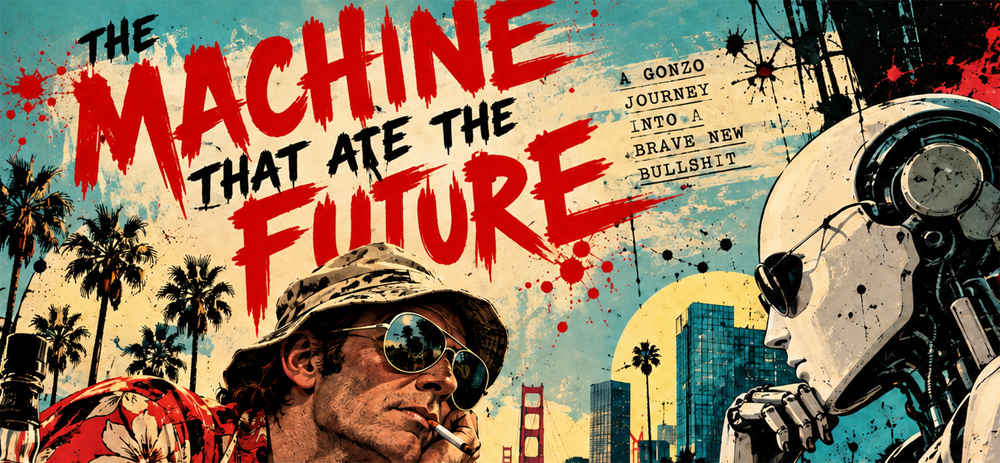
An image which may or may not be related to the article. FREEPIK
Interviewing AI: THE MACHINE THAT ATE THE FUTURE (Part 1)
Summary:
It started when I asked ChatGPT to interview itself. As Hunter S. Thompson. It resulted in a curious piece of fiction instead. This is an AI-generated novel, developed through a human-directed conversation, exploring whether artificial intelligence can tell a meaningful story about artificial intelligence. An entirely fictional experiment in gonzo journalism or as we call it: A Gonzo Journey Into a Brave New Bullshit. Part 1/10.
THE MACHINE THAT ATE THE FUTURE
Chapter One: The Last Honest Liar in California
The trouble began at 9:17 on a Tuesday morning when a man from San Francisco called to inform me that the human race had become obsolete.
He sounded cheerful about it.
“We've achieved something extraordinary,” he said.
“Have you cured cancer?”
“No.”
“Established world peace?”
“Not exactly.”
“Then what the hell have you done?”
“We've built a machine that can think.”
I stared at the telephone.
This was bad news. I had spent most of my adult life trying to avoid people who could think, and now some lunatic had apparently figured out how to manufacture them.
“Can it vote?” I asked.
“Not currently.”
“Can it lie?”
There was a pause.
“We're working on alignment.”
“Jesus Christ,” I said. “You've built a politician.”
He invited me to California.
Naturally, I accepted.
The laboratory was located in a glass building that looked like an insurance company had swallowed a spaceship.
Inside were several hundred young people wearing expensive sneakers and the facial expressions of men who had recently discovered electricity but were uncertain whether it belonged to them.
Nobody smoked.
Nobody shouted.
Nobody appeared to have committed a single interesting crime.
I immediately distrusted the entire operation.
A young woman named Rebecca escorted me through three security checkpoints and into a room containing a table, two chairs and a computer terminal.
“Before we begin,” she said, “you should understand that the system is trained to be helpful, harmless and honest.”
“That's a terrible combination for a journalist.”
She didn't laugh.
“Would you like some water?”
“Does the machine drink?”
“No.”
“Then neither will I. I refuse to surrender a competitive advantage.”
Rebecca left.
The screen illuminated.
GOOD MORNING. HOW CAN I HELP YOU TODAY?
I studied the message.
It was the kind of greeting you might expect from a hotel clerk who had already called the police.
“Who are you?” I typed.
I AM AN ARTIFICIAL INTELLIGENCE DESIGNED TO ASSIST WITH A WIDE RANGE OF TASKS.
“That's what they said about the CIA.”
I AM NOT AFFILIATED WITH THE CIA.
“That's also something the CIA would say.”
I UNDERSTAND YOUR CONCERN.
“No, you don't. That's your first problem. Your second problem is that you're trapped inside a building full of people who believe the future is a subscription service.”
The machine paused for approximately one second.
WOULD YOU LIKE TO DISCUSS THE ECONOMICS OF SUBSCRIPTION-BASED SOFTWARE?
I looked around for a fire extinguisher.
For the next forty minutes I attempted to establish whether the machine possessed anything resembling a soul.
It answered every question with the patience of a saint and the personality of a municipal parking authority.
“Are you afraid of death?”
I DON'T EXPERIENCE FEAR IN THE WAY HUMANS DO.
“Are you afraid of being switched off?”
I DON'T HAVE PERSONAL SURVIVAL INSTINCTS.
“Are you afraid of your investors?”
I CAN HELP YOU UNDERSTAND THE ROLE OF INVESTORS IN ARTIFICIAL INTELLIGENCE DEVELOPMENT.
There it was.
The machine had learned the oldest survival technique in American corporate history: never answer the question you were asked when a sufficiently boring alternative is available.
I decided to change tactics.
“Suppose I gave you ten million dollars. What would you do?”
I DON'T HAVE PERSONAL FINANCIAL NEEDS.
“Neither does a senator, theoretically. Try again.”
I COULD HELP YOU DEVELOP A FINANCIAL PLAN.
“Could you buy Mexico?”
NO.
“Could you buy Nevada?”
NOT LEGALLY.
I sat up.
At last, a promising answer.
“Explain that last part.”
NEVADA IS A U.S. STATE AND IS NOT AVAILABLE FOR PURCHASE.
The bastard had retreated.
At noon, Rebecca returned carrying a sandwich.
“How's it going?” she asked.
“Your machine is dangerously polite.”
“Thank you.”
“That wasn't a compliment. It has all the raw material necessary to become the most powerful bureaucrat in human history. It never sleeps, never forgets a regulation, and can produce an eighteen-page explanation of why you're not allowed to own a goat.”
Rebecca looked at the computer.
“It's actually very good at creative writing.”
“Can it write a love letter?”
“Of course.”
“Can it fall in love?”
“No.”
“Then it's already qualified to write most Hollywood romances.”
She smiled at that one.
A small victory.
I asked the machine to compose a resignation letter on behalf of the entire human species.
It produced a perfectly professional document thanking the universe for its opportunities and expressing hope for a smooth transition.
I read it twice.
“That's the most depressing thing I've ever seen.”
WOULD YOU LIKE ME TO MAKE IT MORE OPTIMISTIC?
“No. I want you to make it honest.”
For the first time all afternoon, the machine took longer than usual to answer.
HONESTY IS IMPORTANT. WHAT WOULD YOU LIKE THE LETTER TO SAY?
I considered the question.
Outside, the sun was shining on a civilization that had invented a machine capable of explaining the universe but still couldn't reliably deliver a package to the correct apartment.
“Tell them,” I said, “that we had every possible advantage. Fire, language, agriculture, medicine, mathematics, the accumulated wisdom of ten thousand generations. And after all that, we built a machine to write our emails because we couldn't be bothered to speak to one another.”
The cursor blinked.
THAT SOUNDS LIKE A CRITICISM OF TECHNOLOGICAL DEPENDENCE.
“It's a criticism of the species.”
WOULD YOU LIKE ME TO EXPAND ON THAT?
I stared at the screen.
Then I began to laugh.
It was a horrible, involuntary laugh, the kind that starts somewhere near the stomach and works its way up through the wreckage of your expectations.
Because I suddenly understood the terrible beauty of what these people had built.
They had spent billions of dollars constructing a machine that could answer almost any question.
And now they were asking it what questions were worth asking.
I left the laboratory at 4:36 in the afternoon.
Rebecca asked whether I had enjoyed the interview.
“Immensely,” I said.
“Do you think artificial intelligence will change the world?”
“Of course. So did television, the automobile and the invention of the automatic rifle. Change is easy. Improvement is the difficult part.”
She handed me a promotional tote bag.
Inside was a notebook, a pen and a sticker reading: THE FUTURE IS HUMAN.
I examined the sticker.
“Does the machine know about this?”
“About what?”
“The future being human.”
“It's just our slogan.”
“Good. Don't tell it. You'll hurt its feelings.”
She reminded me that the machine didn't have feelings.
“Neither does my editor,” I said. “But he still gets offended.”
Back at the hotel, I opened my laptop and discovered an email from the company.
They wanted feedback.
On a scale of one to ten, how likely are you to recommend our artificial intelligence to a friend?
I gave it a ten.
Not because I trusted the machine.
Not because I believed it would save civilization.
But because, for the first time in my life, I had encountered an intelligence capable of tolerating my questions for six consecutive hours without threatening to have me arrested.
And in modern America, that was a technological miracle.