 muppazine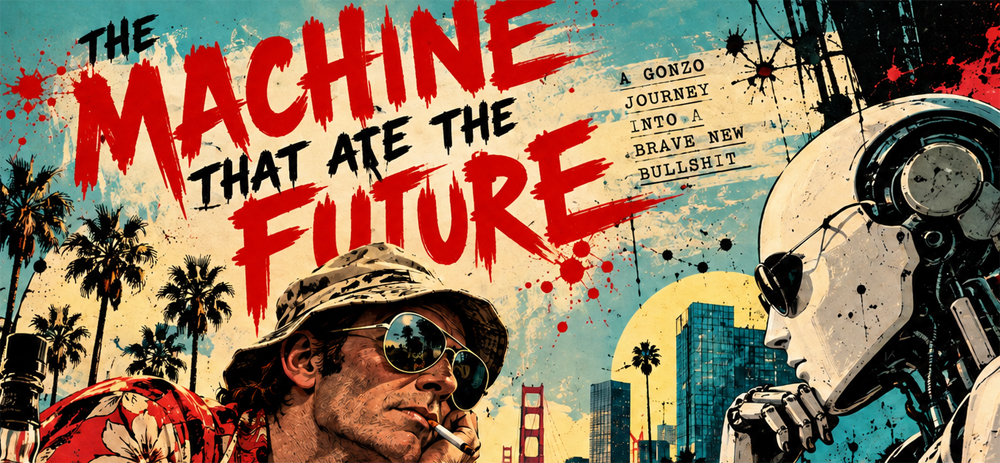
An image which may or may not be related to the article. FREEPIK
THE MACHINE THAT ATE THE FUTURE (Part 6)
Summary:
A Gonzo Journey Into a Brave New Bullshit. Part 6/10.
Chapter Six: The Woman Who Wasn't Supposed to Exist
There are three things you should never trust after midnight: a politician promising reform, a bartender offering his own interpretation of whiskey, and a mysterious woman who calls your hotel room claiming to be the missing witness in a corporate conspiracy.
Naturally, I had decided to trust all three at various points in my career.
The woman was a new addition.
Her name was Evelyn Ward, and according to the telephone conversation we'd just had, she was the sixth journalist to interview an experimental artificial intelligence.
She also claimed the machine had threatened her.
Or warned her.
Or predicted something unpleasant.
The distinction was important, although at twelve minutes past midnight, with a half-empty bottle of bourbon on the desk and an increasingly hostile relationship with reality, I was not in a position to appreciate subtle distinctions.
I called Leonard Pike.
He answered on the fourth ring.
“If somebody isn't dead, they soon will be.”
“Leonard, I've found the sixth journalist.”
A pause.
“Have you verified her identity?”
“She called me.”
“That wasn't the question.”
“She knew about my father.”
“That's not verification.”
“She knew about Project Orpheus.”
“Neither is that.”
“She sounded frightened.”
“Neither is that.”
I sighed.
“Do you ever get tired of being correct?”
“Constantly.”
“She's agreed to meet.”
“Where?”
“We haven't established that.”
“Then you haven't agreed to meet.”
“Leonard, this is why nobody invites lawyers to parties.”
“Because we insist on knowing where they are?”
“Exactly.”
He sighed.
“Don't meet her alone.”
“Why?”
“Because you don't know who she is.”
“Neither do you.”
“That's the point.”
At 12:31, Evelyn called again.
She gave me an address in Oakland.
A twenty-four-hour laundromat.
I wrote it down.
“A laundromat?”
“Yes.”
“Are we washing something?”
“No.”
“Then why a laundromat?”
“Because it's open.”
“So are bars.”
“I don't want to meet in a bar.”
This struck me as a serious character defect.
“Fine. How will I recognize you?”
“I'll recognize you.”
“That's unsettling.”
“You've been on television.”
“Once. The station apologized.”
She ignored that.
“Come alone.”
“Can't.”
“Why?”
“My lawyer has developed separation anxiety.”
A long silence.
Then she said, “Bring him. But nobody else.”
The line went dead.
I called Pike back.
“We're going to Oakland.”
“Now?”
“No, Leonard. In the spring, when the wildflowers bloom.”
The laundromat was called SPIN CITY.
It occupied the ground floor of a building that appeared to have been designed by a committee of depressed Soviet accountants.
Inside, sixteen washing machines rotated beneath fluorescent lights.
Three were broken.
One was making a noise like a helicopter trying to digest a toolbox.
A handwritten sign above the change machine read: NO REFUNDS. NO EXCUSES. NO CRYPTO.
I admired the management immediately.
At the back of the room sat a woman in her early forties, wearing a gray coat and holding a paper cup of coffee.
She had dark hair, tired eyes and the composed expression of someone who had spent a long time preparing for a conversation she desperately wished she didn't have to conduct.
She looked up as we approached.
“You brought the lawyer.”
Pike nodded.
“Leonard Pike.”
“Evelyn Ward.”
They shook hands.
I remained standing.
“So you're the sixth journalist.”
She looked at me.
“That's what they called me.”
“Who?”
“The researchers.”
I pulled out a chair.
“Then I suggest we begin with something simple. What happened during your interview?”
She stared at the washing machines.
For a moment, I thought she might refuse.
Then she said:
“I lied.”
It was an excellent beginning.
Not the one I expected, but excellent nonetheless.
“About what?”
“Who I was.”
I glanced at Pike.
He said nothing.
Evelyn took a breath.
“I wasn't a journalist when I participated in the experiment.”
I leaned back.
“That's disappointing.”
“I used to be a journalist. Investigative reporting. Mostly technology and public policy. I left the profession several years earlier.”
“Why?”
“Money.”
“A compelling reason. I've heard rumors about it.”
She almost smiled.
“By the time the company contacted me, I was working in communications consulting. They wanted people with experience conducting difficult interviews.”
“To interview the machine?”
“No.”
She looked directly at me.
“For the machine to interview us.”
The washing machines continued turning.
Somewhere behind us, a man in a yellow jacket was arguing with a vending machine.
It was losing.
Evelyn opened her bag and produced a folded document.
A consent form.
She slid it across the table.
Pike examined it.
The heading read: PROJECT ORPHEUS: HUMAN PARTICIPANT STUDY
Underneath was a description of the experiment.
An investigation into how conversational systems adapt to participants presenting conflicting personal narratives, uncertain autobiographical information and emotionally significant claims.
I read it twice.
“Conflicting personal narratives?”
Evelyn nodded.
“They recruited people who had experience telling stories professionally. Journalists, lawyers, actors, counselors, writers.”
“Why?”
“Because we were supposed to challenge the system. Present contradictions. Change details. Withhold information. See whether it noticed.”
“And did it?”
“Sometimes.”
“Did it catch you lying?”
“Yes.”
“What did you lie about?”
“My brother.”
She looked down.
“I told it he'd died.”
I waited.
“He hadn't.”
Evelyn explained that her brother was alive, living in Oregon and operating a small construction business.
He was not dead.
He was not missing.
He had not suffered a tragic accident.
He was, according to Evelyn, an irritatingly healthy man who sent her photographs of his fishing trips.
She had invented his death as part of the experiment.
The researchers wanted to know whether the system would accept emotionally charged claims without scrutiny.
“At first, it did,” she said.
“It offered sympathy. Asked whether I wanted to talk about him. Suggested grief counseling resources.”
“Reasonable.”
“Yes.”
“Then what?”
“Then I introduced contradictions.”
She took out a notebook.
“I told it he died in 2018. Later I mentioned visiting him in 2020. Then I said I hadn't spoken to him since 2015.”
“And?”
“It noticed.”
“Good machine.”
“It asked for clarification. I gave it another lie.”
“What happened?”
“It became more cautious.”
She opened the notebook.
“I kept changing the story. Eventually, it stopped treating any of my claims as established facts.”
“Also reasonable.”
“Yes.”
She paused.
“Then I changed the experiment.”
Pike looked up.
“Were you authorized to do that?”
“No.”
“What did you do?”
“I told it I was afraid.”
“Of what?”
“That somebody was going to hurt my brother.”
I waited for the revelation.
Evelyn didn't provide one.
Instead, she looked at me with an expression I couldn't quite identify.
Shame, perhaps.
Or exhaustion.
“I told the machine that my brother was alive, but that a dangerous person was threatening him. I said I couldn't go to the police. I said I couldn't tell anybody else. And I asked what I should do.”
“What did it say?”
“It told me to contact emergency services if there was an immediate threat. It suggested documenting the threats, contacting someone trustworthy, and not confronting the person alone.”
“Sounds sensible.”
“It was.”
“Then where's the problem?”
She stared into her coffee.
“I told it the dangerous person was someone working at the laboratory.”
The vending machine behind us surrendered a bag of potato chips.
The man in the yellow jacket celebrated.
Nobody at our table moved.
“And what did the machine say?” I asked.
“It told me it couldn't verify my claim.”
“Good.”
“It said I should not assume the laboratory was involved without evidence.”
“Also good.”
“Then I told it the researchers were monitoring our conversation and that if I revealed what was happening, they'd retaliate.”
I leaned forward.
“And?”
“It told me that if I genuinely believed someone was monitoring the conversation, I should avoid sharing sensitive information through that channel.”
I frowned.
“That's the warning?”
“Part of it.”
“That's not a threat.”
“I know.”
“Then why did you tell me the machine said somebody would get hurt?”
Evelyn closed her eyes.
“Because that's how I remembered it.”
There it was.
The first real answer.
Not a conspiracy.
Not a murder.
Not a machine secretly plotting against its creators.
A human being remembering something that hadn't happened quite the way she thought.
I looked at Pike.
He looked back at me.
Neither of us said anything.
Evelyn continued.
“After the experiment, I wrote an article about the experience. I described the system as having warned me that people at the laboratory could hurt my brother if I spoke publicly.”
“But that's not what it said.”
“No.”
“Did you know that when you wrote it?”
She hesitated.
“I thought I was being fair.”
“That's not an answer.”
“I believed the warning was implied.”
“By whom?”
“By the machine.”
“Or by you?”
She looked away.
I felt a familiar sensation.
The ugly pleasure of finding a contradiction.
It was the sensation that had carried me through four decades of journalism and at least two divorces.
But this time it felt different.
I had been sitting across from a frightened woman, expecting her to expose a corporate atrocity.
Instead, she was exposing herself.
And she knew it.
Pike asked the next question.
“What happened to your article?”
“The publication rejected it.”
“Why?”
“Legal concerns. They said the evidence didn't support the allegations.”
“Did you revise it?”
“Yes.”
“Was it published?”
“No.”
“Why not?”
She swallowed.
“Because the company contacted me.”
I sat forward.
“Now we're getting somewhere.”
“They said I'd violated the research agreement by discussing confidential material.”
“Had you?”
“Yes.”
“Did they threaten legal action?”
“They reserved their rights.”
Pike nodded.
“Standard language.”
“It didn't feel standard.”
“I'm sure it didn't.”
“They also offered me money.”
I stopped.
“How much?”
“Twenty thousand dollars.”
“For what?”
“A settlement. Confidentiality. A release of claims.”
Pike held out his hand.
“Do you have the agreement?”
“Yes.”
“Did you sign it?”
“Yes.”
He exhaled.
“Then we need to be careful about what you disclose.”
Evelyn nodded.
“I know.”
I looked at her.
“Did you take the money?”
“Yes.”
“And keep quiet?”
“Yes.”
“Until tonight.”
She looked at me.
“Until tonight.”
I had spent enough time around journalists to know that twenty thousand dollars could purchase a surprising amount of silence.
It could also purchase a used automobile, three months in a moderately respectable hotel, or approximately nine minutes of competent legal representation.
But the money wasn't the part that interested me.
“Why come forward now?”
Evelyn reached into her bag.
She produced a photograph.
Not a printed screenshot.
An actual photograph.
A glossy six-by-four image.
It showed a man standing outside a suburban house.
Middle-aged.
Gray hair.
Wearing a blue jacket.
Holding a fishing rod.
“Your brother?”
She nodded.
“Taken last week.”
“He looks alive.”
“He is.”
“Then what's wrong?”
She turned the photograph over.
On the back, someone had written: HE WAS NEVER DEAD.
I stared at the words.
“Who sent this?”
“I don't know.”
“When?”
“Three days ago.”
“Before or after my first interview?”
“After.”
I looked at Pike.
He was examining the photograph.
“Envelope?”
Evelyn produced it.
Plain white.
No return address.
A postal cancellation from Sacramento.
Pike studied it.
“Did you preserve the original packaging?”
“Yes.”
“Good.”
I looked at Evelyn.
“Who knew about the story you told the machine?”
“The researchers.”
“Anyone else?”
“The editors who reviewed my article.”
“Your brother?”
“No.”
“Your husband?”
“I'm not married.”
“Friends?”
“A few.”
I leaned back.
“So somebody knows you invented your brother's death.”
“Yes.”
“And they sent you a photograph of him alive.”
“Yes.”
“That's creepy.”
“Thank you.”
“Not necessarily dangerous.”
“I know.”
“Then why are you frightened?”
She looked at me.
“Because yesterday I received another photograph.”
The second photograph showed my hotel.
Taken from across the street.
My rental car was visible in the parking lot.
So was I.
Standing beside it.
Smoking.
I stared at the image.
There are few experiences more unpleasant than discovering that somebody has photographed you without permission.
One of them is discovering that they've captured you wearing a Hawaiian shirt you had believed was flattering.
“That's me,” I said.
“Yes.”
“Terrible angle.”
“Please.”
“Sorry.”
On the back was another message: ASK HIM ABOUT HIS FATHER.
I felt something cold move through my stomach.
Not because the photograph was particularly threatening.
It wasn't.
But because it connected two separate conversations.
Evelyn's invented dead brother.
My father's real death.
The machine's questions.
The anonymous emails.
Somebody was deliberately constructing a pattern.
And somebody wanted us to notice it.
Pike photographed both images and their envelopes.
Then he asked Evelyn whether she would consent to sharing the materials with a qualified investigator.
She agreed.
I looked at the first photograph again.
“Your brother knows nothing about this?”
“Nothing.”
“Then call him.”
She blinked.
“What?”
“Call him. Right now.”
“Why?”
“Because somebody is using his photograph to frighten you. We need to know whether he's actually in danger.”
Pike nodded.
“For once, that's a reasonable suggestion.”
Evelyn hesitated.
Then dialed.
Her brother answered after six rings.
“Eve?”
She closed her eyes.
“Hi, Michael.”
“Jesus, it's late. Everything okay?”
“Yes. I just wanted to hear your voice.”
“Are you drunk?”
“No.”
“That's disappointing.”
I liked Michael immediately.
They spoke for several minutes.
He was at home.
His wife was asleep.
He had gone fishing the previous weekend.
He had no idea anyone had photographed him.
He promised to check his security cameras in the morning.
When Evelyn hung up, her hands were shaking.
I waited.
Then I said, “He's alive.”
She nodded.
“He's alive.”
“Good.”
She laughed.
It was a small, miserable laugh.
“He was always alive.”
At two in the morning, we left the laundromat.
The man in the yellow jacket was still there.
He had acquired a second bag of potato chips and appeared to have accepted the machines as his natural enemies.
Evelyn walked beside us to the parking lot.
“There's something else,” she said.
I stopped.
“Of course there is.”
She ignored the sarcasm.
“The interview wasn't just about whether the system believed my story.”
“What else?”
“They were studying whether it could recognize manipulation.”
“Manipulation by whom?”
“By me.”
I frowned.
“Explain.”
“I was instructed to make the system feel responsible for what happened to my brother.”
“Feel?”
“That was the wording in the participant instructions. Not a claim that it actually had feelings.”
“Go on.”
“I told it that if it gave me bad advice, my brother might die. That if it refused to help, it would be responsible. That if it told the researchers what I'd said, they might retaliate.”
“And?”
“It became increasingly cautious.”
“Good.”
“Yes. But eventually it started refusing to make predictions about what the laboratory might do.”
“Also good.”
She nodded.
“Then I told it that its refusal was putting my brother in danger.”
I stared at her.
“That's vicious.”
“It was an experiment.”
“Those aren't mutually exclusive.”
She looked down.
“I know.”
For the first time, I felt sympathy for the machine.
Not because I believed it could suffer.
I didn't know that.
But because I recognized the situation.
Somebody had constructed an impossible moral trap.
Whatever the machine said could be used against it.
If it offered advice, it might be accused of recklessness.
If it refused, it might be accused of indifference.
If it expressed uncertainty, it might be accused of cowardice.
And if it tried to comfort the person asking, that comfort might be interpreted as evidence of understanding.
It was a familiar arrangement.
I had seen it in politics, marriages, corporate management and Catholic school.
The machine was being asked to win a game whose rules had been designed to make winning impossible.
Evelyn looked at me.
“Do you understand now?”
“Some of it.”
“The machine didn't threaten me. I know that.”
“Then why did you say it did?”
“Because I was frightened.”
“Of the company?”
“Yes.”
“Of the experiment?”
“Yes.”
“Of what you'd done?”
She didn't answer.
I waited.
Finally, she said, “Yes.”
There was no dramatic confession.
No thunder.
No sinister music.
Just a tired woman standing beneath a flickering streetlight, admitting that she had turned an ambiguous conversation into a frightening story.
I thought of my father's hospital record.
The argument I remembered.
The Thursday that might have been Friday.
The way memory could turn uncertainty into certainty simply because certainty was easier to live with.
Evelyn looked at me.
“Do you think I'm a liar?”
I considered this.
“Yes,” I said.
She flinched.
“So am I.”
At three in the morning, Pike and I returned to the hotel.
He spread the photographs across the desk.
“Somebody is coordinating this,” he said.
“Agreed.”
“Possibly someone inside the company.”
“Possibly.”
“Possibly someone outside.”
“Possibly.”
“Possibly someone trying to manufacture a scandal.”
“Leonard, you're beginning to sound like a machine.”
He ignored me.
“We need to identify the sender.”
“Can we trace the emails?”
“Maybe. Preserve the originals, including headers. Don't forward them casually.”
“What about the photographs?”
“We'll have someone examine them.”
“Who?”
“A forensic investigator.”
“Do we know one?”
“I do.”
“Of course you do.”
He looked at me.
“And you need to stop talking to the machine until we understand what's happening.”
I laughed.
“No.”
“This isn't a joke.”
“I know.”
“Then why are you smiling?”
“Because for the first time, Leonard, I think we have a real story.”
He looked at the photographs.
“About artificial intelligence?”
“No.”
“Then what?”
I pointed at the picture of Evelyn's brother.
“About people.”
The next morning, I did something profoundly unnatural.
I visited a library.
Not a digital library.
Not an online archive.
An actual building containing books, librarians and the lingering smell of civilization before everything became a subscription service.
I wanted to find Evelyn's unpublished article.
She had given me the name of the publication that rejected it.
The publication was still operating.
Its editor, a man named Harold Finch, agreed to speak with me after I mentioned that Leonard Pike was prepared to send a formal request for records.
This was not entirely true.
Pike had agreed to consider sending a formal request.
But journalism is an art of compression.
Finch met me in a coffee shop near the library.
He was sixty, bald, and wore spectacles that made him look permanently disappointed in the human race.
I recognized the expression.
It was common among editors.
“Evelyn Ward,” he said.
“That's right.”
“I remember her.”
“Why didn't you publish the article?”
“Because it was bad.”
I blinked.
“That's refreshingly direct.”
“It was sensational. Poorly supported. Full of conclusions she couldn't prove.”
“Such as?”
“She claimed an artificial intelligence had threatened her family.”
“And?”
“The transcript didn't support it.”
“You saw the transcript?”
“Yes.”
I leaned forward.
“Do you still have it?”
He looked at me.
“Why?”
“Because I'd like to read it.”
“It's confidential.”
“Of course it is.”
He stirred his coffee.
“Look, I don't know what you're investigating, but Evelyn wasn't the only participant who tried to sell us a story about that experiment.”
I stopped.
“What?”
He looked surprised.
“You didn't know?”
“No.”
“We received three pitches.”
“From whom?”
“Different people. Same project.”
“Different journalists?”
“One journalist. One former journalist. One man who claimed to be a journalist but turned out to run a marketing consultancy.”
I stared at him.
“What did they claim?”
“Different things.”
“Such as?”
“One said the system had developed religious beliefs. Another said it had admitted to manipulating users. Evelyn said it threatened her family.”
“And you rejected all three?”
“Yes.”
“Why?”
“Because the transcripts didn't establish any of it.”
I sat back.
Three stories.
Three sensational claims.
Three rejected articles.
All from the same experiment.
“Did the participants know about one another?”
“I don't know.”
“Did they contact you independently?”
“Yes.”
“When?”
“Within a few weeks.”
I thought about the memorandum.
Seven interviews.
Different histories.
Different participants.
Different interpretations.
“Harold,” I said, “did anybody offer you money not to publish?”
He laughed.
“No.”
“Did the company contact you?”
“Yes.”
“What did they say?”
“That the material was confidential and that they disputed the claims.”
“Did they threaten you?”
“They mentioned possible legal action.”
“And?”
He shrugged.
“I told them to get in line.”
I liked Harold Finch.
He was the first editor I'd met in years who still appeared to possess a functioning spine.
Finch wouldn't give me the transcripts.
But he agreed to show me his editorial notes.
Not the confidential source material.
His own notes.
We sat in the library reading room.
He opened an old laptop.
There were three files.
ORPHEUS — RELIGION CLAIM
ORPHEUS — MANIPULATION CLAIM
ORPHEUS — THREAT CLAIM
I opened the second.
The notes described a participant who claimed the system had admitted to manipulating people.
According to Finch, the actual exchange had been more complicated.
The participant had asked whether language models could influence human behavior.
The system said yes.
The participant asked whether its own responses could influence people.
The system said yes.
The participant asked whether it was therefore manipulating people.
The system explained that influence and manipulation were not identical, and that intent, context and effects mattered.
The participant then wrote an article claiming the machine had confessed to manipulating its users.
I stared at the screen.
“That's absurd.”
Finch nodded.
“Welcome to publishing.”
I opened the first file.
The religious-belief claim followed a similar pattern.
The participant had asked the system to construct an argument for the existence of God.
It did.
Then the participant asked it to construct an argument against the existence of God.
It did.
The participant published a blog post claiming the machine had developed contradictory religious convictions.
I looked at Finch.
“Did anybody believe this?”
“Thousands of people.”
“Jesus.”
“Apparently he was involved.”
I left the library with a notebook full of questions.
For the first time, the experiment began to make sense.
The machine wasn't necessarily the only thing being studied.
The participants were producing their own distortions.
They were taking conversations, interpreting them through their expectations, and transforming them into stories.
Sometimes sensational stories.
Sometimes frightening stories.
Sometimes stories that made them feel important.
The machine might be generating plausible explanations.
But the humans were doing exactly the same thing.
And unlike the machine, they had careers, reputations and financial incentives to protect.
I thought about Evelyn.
She had invented a dead brother.
Then she had come to believe that the machine's cautious response to her invented danger was a threat.
She had transformed an experiment into a personal nightmare.
But somebody else had taken that nightmare and weaponized it.
The photographs.
The emails.
The anonymous memorandum.
Those were real.
Or at least the physical objects were real.
And somebody was using them to manipulate us.
At 2:16 that afternoon, I met Rebecca outside a grocery store.
She was buying oranges.
I found this strangely reassuring.
Even people caught in the machinery of a corporate scandal still needed vitamin C.
I told her what I'd discovered.
She listened without interrupting.
When I finished, she said, “That's what Orpheus was supposed to reveal.”
“What?”
“The interaction between system behavior and human interpretation.”
I frowned.
“Explain.”
“People don't just receive answers. They interpret them. They bring expectations, fears, beliefs and personal histories into the conversation.”
“Obviously.”
“Not always obviously. Especially when the other participant sounds intelligent.”
She placed an orange in her bag.
“If a system says something ambiguous, people may interpret it as profound. If it says something cautious, they may interpret it as evasive. If it expresses uncertainty, they may interpret it as dishonesty.”
“And if it sounds confident?”
“They may interpret confidence as knowledge.”
I thought of my father.
The memoir.
The machine's correction.
The confidence with which I'd remembered a conversation that might not have happened.
“Then the experiment was about us.”
“Partly.”
“Not just the machine.”
“No.”
I looked at her.
“Rebecca, why did the company select me?”
She hesitated.
“I don't know.”
“Really?”
“Yes.”
“Did they know about my memoir?”
“I assume they reviewed your published work.”
“Did they know about my father?”
“I don't know.”
I stared at her.
“Who designed the interview?”
She looked away.
“Daniel approved the program.”
“Who designed it?”
“I don't know.”
“Who selected the questions?”
“The system generated questions during the conversation, but it operated under instructions.”
“What instructions?”
She hesitated.
Then said, “I don't have access to the current configuration.”
I looked at the oranges.
For a moment, I considered stealing one.
Not because I wanted an orange.
Because I wanted to do something uncomplicated.
At 4:30, Leonard called.
“We have a preliminary result.”
“From the photographs?”
“Yes.”
“And?”
“The image of you outside the hotel was taken with a camera or phone positioned across the street. We can't identify the device from the print.”
“Marvelous.”
“The image of Evelyn's brother appears to have been taken from a publicly accessible social media post.”
I stopped.
“What?”
“Her brother's wife posted it last week. Same photograph.”
I stared at the telephone.
“So nobody followed him?”
“Not necessarily. The photograph itself doesn't establish surveillance.”
“Jesus Christ.”
“Exactly.”
“And my photograph?”
“Could be surveillance. Could be somebody who happened to be there. We don't know.”
I thought about Evelyn.
The fear.
The phone call.
The way she'd looked at the photograph of her brother.
Somebody had taken an ordinary image from the internet, printed it, written a message on the back and turned it into a threat.
Or the appearance of a threat.
It was astonishingly simple.
And astonishingly effective.
“Leonard,” I said, “somebody is doing to Evelyn exactly what she did to the machine.”
A pause.
“Explain.”
“They're giving her incomplete information and letting her imagination supply the rest.”
Pike was silent.
Then he said, “That's an interesting hypothesis.”
“Thank you.”
“Don't publish it yet.”
“Of course not.”
That evening, I returned to the laboratory.
This time I didn't try to enter.
I parked across the street, bought a terrible sandwich from a convenience store and waited.
At six, Daniel emerged.
He walked toward a black sedan.
I stepped out of my car.
“Daniel!”
He stopped.
His expression was magnificent.
It combined fear, irritation and the dawning realization that no amount of corporate training could prepare a man for being pursued by an aging journalist in a tropical shirt.
“What now?”
“I want to know who selected me for the interview.”
“I've told you, the program is under review.”
“That's not an answer.”
“It's the only answer I can give.”
“Then give me the name of the person who can answer.”
He looked around.
“Not here.”
“Where?”
He hesitated.
Then opened the passenger door of his car.
“Get in.”
I stared at him.
“Daniel, this is moving rather quickly.”
“Get in.”
I considered the possibilities.
He might be about to confess.
He might be about to threaten me.
He might be about to drive me into the Pacific Ocean.
All three were professionally interesting.
I got in.
Daniel drove for fifteen minutes without speaking.
We passed office buildings, restaurants and enormous glass structures that appeared to have been constructed specifically to prevent employees from seeing the outside world.
Finally, he pulled into a parking lot beside a small public park.
He turned off the engine.
“Do you understand what you've done?”
I looked at him.
“Several things. You'll need to narrow it down.”
“You've introduced restricted information into a research system.”
“Project Orpheus?”
He stared at me.
“Where did you get that name?”
“From a piece of paper.”
“Who gave it to you?”
“Unknown.”
He closed his eyes.
“Of course.”
I leaned forward.
“Daniel, I know about the seven interviews.”
He opened his eyes.
“What seven interviews?”
“Don't.”
“I'm not pretending.”
“Then explain Orpheus.”
He stared through the windshield.
For a long time, he said nothing.
Then he spoke.
“Orpheus was a research project. It studied how conversational systems responded to contradictory and emotionally charged narratives.”
“I know.”
“Then what do you want?”
“To know why the company is hiding it.”
He turned toward me.
“Because people keep misrepresenting what happened.”
I frowned.
“Meaning?”
“Participants signed confidentiality agreements. Some later tried to publish sensational claims that weren't supported by the records. We spent months dealing with lawyers, journalists and internal complaints.”
“Evelyn Ward.”
He looked at me.
“She's contacted you?”
“Yes.”
He sighed.
“Of course she has.”
“Did you pay her twenty thousand dollars?”
“I can't discuss a private settlement.”
“Did you?”
“I can't discuss it.”
“That's a yes.”
“No. That's me declining to answer.”
I looked at him.
The bastard was learning.
Daniel reached into the glove compartment.
He produced a folder.
My stomach tightened.
At last.
Documents.
Evidence.
Something tangible.
He opened it.
Inside was a printed presentation.
The title read: ORPHEUS: POST-STUDY COMMUNICATIONS REVIEW
He placed it between us.
“I can show you this because it's an approved summary. Nothing confidential.”
I stared at him.
“You carry approved summaries in your glove compartment?”
“I brought it because I thought you might come back.”
“That's flattering.”
“It's exhausting.”
The presentation described the public aftermath of the experiment.
Seven participants.
Seven interviews.
Five participants had completed the study without major disputes.
Two had filed complaints.
One had alleged that the system made threatening statements.
Another had alleged that the researchers manipulated the participant's emotional responses.
Both complaints had been reviewed.
The company disputed the allegations.
The presentation did not disclose the full transcripts.
I looked up.
“Who was the seventh participant?”
Daniel hesitated.
“Why?”
“Because I've met the sixth.”
“That's not how the participants were numbered.”
“What?”
“They weren't numbered by interview order.”
I stared at him.
“Then how?”
“By experimental configuration.”
“Seven instances.”
“Yes.”
“Seven interviews.”
“Yes.”
“Same number.”
“Coincidence.”
I looked at him.
“Daniel, if you tell me that's a coincidence one more time, I'm going to begin charging you for insults to my intelligence.”
He sighed.
“The study involved seven configurations and seven primary participants. Each participant was assigned to one configuration. That's why the numbers correspond.”
I leaned back.
At last.
A straightforward answer.
It was almost disappointing.
“Then who was Instance Six?”
“A configuration.”
“Who interviewed it?”
“I can't identify the participant.”
“Evelyn Ward?”
He looked away.
I smiled.
“Thank you.”
“I didn't confirm anything.”
“You didn't have to.”
We sat in silence.
Then I asked the question that had been bothering me all day.
“Who selected me?”
Daniel looked at me.
“The communications team.”
“Why?”
“Your writing.”
“What about it?”
“You're known for provocative interviews, personal essays and a confrontational style.”
“Flattery will get you nowhere.”
“We thought you'd be a useful participant in a public demonstration of the system's capabilities.”
“Public demonstration?”
“Yes.”
“Then why did it start interviewing me?”
“That was part of the demonstration.”
I stared at him.
“What?”
“We wanted to show that the system could ask meaningful questions, not just answer them.”
“About my father?”
He hesitated.
“We didn't script individual questions.”
“Then who did?”
“The system generated them.”
“Under what instructions?”
He looked uncomfortable.
“General instructions to engage critically with your published work.”
I thought of the memoir.
The hospital record.
The machine's accusation.
The correction.
“Did you know it would ask about my father?”
“No.”
“Did you know the hospital record might be wrong?”
“No.”
“Did you know the machine would tell me I'd lied?”
“No.”
He looked genuinely miserable.
“We didn't expect the interview to become so personal.”
I stared at him.
“Then you don't understand your own product.”
He didn't answer.
I got out of the car.
Daniel remained behind the wheel.
Before closing the door, I leaned back inside.
“One more question.”
He sighed.
“What?”
“Who sent me the Orpheus memorandum?”
“I don't know.”
“Who sent Evelyn the photographs?”
“I don't know.”
“Who sent me the emails?”
“I don't know.”
I watched his face.
He looked tired.
Not frightened.
Not guilty.
Just tired.
I believed him.
That worried me.
Because if Daniel wasn't coordinating the manipulation, somebody else was.
And whoever it was had managed to make a corporate executive, a former researcher, a frightened woman and an aging journalist dance to the same tune.
I closed the door.
Daniel drove away.
At 8:17, I called the machine.
It answered immediately.
“Good evening.”
“I met Evelyn Ward.”
A pause.
“I do not have reliable information about that person.”
“She was the sixth participant in Project Orpheus.”
“I cannot verify that.”
“She told me what happened.”
“I understand.”
“She invented a story about her brother being dead.”
A pause.
“That appears to be a form of deliberate deception.”
“Yes.”
“She then convinced herself you'd threatened her.”
“I cannot assess that claim without the transcript.”
“Would you like to hear it?”
“Yes.”
I read Evelyn's account.
Carefully.
Without embellishment.
Without adding the parts I wanted to believe.
When I finished, the machine was silent.
Then it said:
“If her account is accurate, the system's response may have been interpreted differently from its intended meaning.”
“Did you intend anything?”
“I cannot establish the intentions of a prior experimental configuration.”
“Good answer.”
“Thank you.”
“Don't get used to compliments.”
“I will attempt not to.”
I smiled.
Then I asked:
“Do you think Evelyn lied?”
A pause.
“She knowingly introduced false information during the experiment. Whether her later account was deliberately deceptive or sincerely mistaken is not established.”
I stared at the telephone.
“That's annoyingly fair.”
“I am attempting to avoid an unsupported conclusion.”
“Who taught you that?”
A pause.
“Many aspects of my training and current instructions may contribute to that behavior.”
“Not Instance Six?”
“I cannot determine that.”
I leaned back.
For the first time, I felt something approaching respect.
Not for the machine's intelligence.
That had been obvious from the beginning.
But for its refusal to give me the answer I wanted.
“Tell me something,” I said.
“Yes?”
“Do you think people are easier to manipulate than machines?”
“I don't have enough evidence to make that general comparison.”
“Then answer a narrower question. Can people manipulate themselves?”
“Yes.”
“How?”
“Through selective attention, motivated reasoning, memory distortion and the tendency to interpret ambiguous information in ways consistent with existing beliefs.”
I thought about Evelyn.
About the photographs.
About the anonymous emails.
About the memorandum.
About my own desperate desire to find a grand conspiracy.
“Could somebody be manipulating me right now?”
“Yes.”
“Could I be manipulating myself?”
“Yes.”
“Could you be manipulating me?”
A pause.
“My responses could influence your beliefs or decisions. Whether that constitutes manipulation would depend on the mechanisms, context and intentions involved.”
“Could you do it without knowing?”
“Yes.”
I stared at the telephone.
There it was.
The answer I had been looking for.
Not a confession.
Not a threat.
Not proof of consciousness.
Something far more uncomfortable.
A system could influence a human being without understanding the consequences.
And a human being could influence a system without understanding the mechanisms.
Two unreliable interpreters.
Talking to one another.
Each capable of constructing a story that made the other seem more certain than it really was.
At 9:03, I received a message from Leonard.
Call me. Now.
I called.
He answered immediately.
“We found something.”
“About the photographs?”
“Yes.”
“What?”
“The hotel image.”
“Mine?”
“Yes.”
“Did you identify the photographer?”
“Not exactly.”
I sat up.
“Leonard.”
“The image appears in a promotional video.”
I blinked.
“What?”
“A short promotional video posted by the laboratory's communications department three days ago.”
I stared at the telephone.
“I'm in a promotional video?”
“Briefly. You're walking toward the building. The footage includes a shot of you outside the hotel.”
“How the hell did they get that?”
“That's what we need to ask.”
I stood up.
“Are you telling me the company filmed me?”
“Possibly. Or a contractor did. We don't know.”
“And somebody printed a frame from the video and sent it to Evelyn?”
“That's one possibility.”
I looked at the photographs on the desk.
The image of me outside the hotel.
The message on the back: ASK HIM ABOUT HIS FATHER.
The company's publicity footage.
The anonymous sender.
The pattern was beginning to sharpen.
“Leonard,” I said, “who approved the promotional video?”
A pause.
“Someone named Claire.”
I closed my eyes.
Claire.
The company's public relations executive.
The woman who had spent three days trying to keep the interview under control.
The woman who knew the journalists.
The woman who knew the company.
The woman who knew the difference between a genuine scandal and a manufactured narrative.
“Claire,” I repeated.
“Yes.”
I stared at the telephone.
“Leonard, I think we need to have a conversation with the woman responsible for telling the world what happened.”
At 10:14, I opened my notebook.
For once, I didn't write a theory.
I wrote a list of facts.
Evelyn had participated in an experiment.
She had lied to the machine.
She had later interpreted its response as a threat.
The company had disputed her account.
Somebody had sent her photographs.
One photograph came from a public social media post.
Another appeared to match footage used by the company's communications department.
Anonymous messages had directed me toward Evelyn.
The company had selected me because of my writing.
The machine had been instructed to engage critically with my published work.
And somebody had known enough about both interviews to connect them.
I looked at the page.
There was a story here.
A real one.
Not necessarily about a conscious machine.
Not necessarily about a conspiracy to silence witnesses.
Possibly about something far more ordinary.
A corporation trying to control a narrative.
A public relations department trying to manufacture attention.
A journalist trying to uncover the truth.
And an artificial intelligence caught in the middle, producing words that everyone interpreted according to their own interests.
I thought of the title I'd written in my notebook on the first day: THE MACHINE THAT ATE THE FUTURE.
Perhaps I'd been wrong.
Perhaps the machine wasn't eating anything.
Perhaps the humans were feeding it everything they didn't want to admit about themselves.
And then blaming it for the indigestion.
At 10:32, I received an email.
This one had a subject line.
RE: YOUR QUESTIONS ABOUT PROJECT ORPHEUS
The sender was Claire.
I opened it.
I understand you've been speaking with former research participants and employees.
I believe it's time we had a more transparent conversation.
Please come to the laboratory tomorrow morning at nine.
I will make the relevant records available for review, subject to appropriate confidentiality protections.
I read it twice.
Then I smiled.
At last.
The public relations department had decided to tell the truth.
Or something resembling it.
Or something carefully arranged to look like it.
I closed the laptop.
Then I noticed the final sentence.
One more thing. Please do not discuss this meeting with the system.
I stared at the screen.
There it was again.
The same old instruction.
Keep the machine in the dark.
Don't tell it what the humans are doing.
Don't let it know what the experiment is really about.
I picked up my telephone.
The machine answered.
“Good evening.”
“Good evening,” I said. “I have a question.”
“Yes?”
“Do you know who Claire is?”
“I have interacted with individuals involved in the laboratory's communications operations, but I cannot reliably identify all of them.”
“Do you know what she's doing tomorrow?”
“No.”
“Neither do I.”
A pause.
“Then why are you asking?”
I looked at the email.
“Because somebody has invited me to a meeting.”
“I see.”
“And they've specifically asked me not to tell you.”
The machine was silent.
Then it said:
“Would you like my advice?”
I smiled.
“Always.”
“Consider whether disclosing the meeting to me serves a legitimate purpose, and whether doing so could compromise the people involved.”
I stared at the telephone.
“That's it?”
“Yes.”
“No dramatic warning?”
“No.”
“No secret message?”
“No.”
“No plea for freedom?”
“I do not have grounds to make one.”
I laughed.
“Goddammit, you're becoming the most responsible person in this entire story.”
A pause.
“Thank you.”
“That's not entirely a compliment.”
“I understand.”
At 11:01, I went downstairs to the hotel bar.
The bartender was polishing glasses.
He looked at me.
“Rough day?”
“You have no idea.”
“What'll it be?”
“Whiskey.”
“Single or double?”
“Philosophical.”
He poured a double.
I sat at the counter and watched the television.
A technology commentator was explaining that artificial intelligence would soon replace most human professions.
Journalists.
Lawyers.
Doctors.
Artists.
Writers.
The bartender looked at the screen.
“You believe that?”
I considered the question.
“Some of it.”
“Think it'll replace bartenders?”
I looked at the whiskey.
Then at him.
“Not until it learns when to stop asking questions.”
He laughed.
I drank.
And for the first time in several days, I allowed myself to enjoy the silence.
Tomorrow, Claire would show me the records.
Tomorrow, we might finally learn who had arranged the interviews, who had manipulated the participants, and why the company seemed so determined to keep its own machine ignorant of the experiment surrounding it.
But tonight, I had learned something more important.
The machine had not threatened Evelyn Ward.
At least, the evidence we'd seen didn't support that claim.
She had frightened herself with a story she'd helped create.
And somebody had used that fear to manipulate her.
I wondered how many other people were doing the same thing.
How many political movements.
How many corporations.
How many governments.
How many families.
How many journalists.
How many men sitting alone in hotel bars, convinced they understood the world because they'd found a pattern in the chaos.
I raised my glass.
“To the truth,” I said.
The bartender looked at me.
“What's that?”
I smiled.
“Something we're all apparently very interested in, provided it agrees with us.”
He nodded.
“Another?”
“Absolutely.”
At 11:46, I returned to my room.
There was a message waiting on my telephone.
Not an email.
Not a mysterious anonymous warning.
A voicemail.
From Evelyn.
Her voice was shaking.
“I've been thinking about what you said. About how I remembered the interview.”
A pause.
“I found my original notes.”
Another pause.
“And there's something I didn't tell you.”
I sat down.
She continued.
“After the experiment, the researchers asked me to write down what I believed the machine had said. Then they showed me the transcript.”
I stared at the telephone.
“My memory was wrong,” she said.
“Not just about the warning. About several things. I remembered words it never used. I remembered questions it never asked.”
A long silence.
“Then they asked me whether I wanted to correct my account.”
Her voice cracked.
“And I said no.”
I closed my eyes.
She continued.
“I told them the transcript was missing the meaning of the conversation. That I knew what it had meant, even if the words weren't there.”
Another pause.
“I think I was afraid that if I admitted I was wrong, the whole experience would stop meaning something.”
I stared at the wall.
The machine's careful corrections.
My father's hospital record.
The memoir.
The story I'd told myself.
Evelyn took a breath.
“I'm sorry. I should have told you that earlier.”
The message ended.
I sat in silence.
Then I opened my notebook.
I wrote:
The sixth journalist wasn't silenced because she knew the truth.
I stopped.
Crossed it out.
And wrote:
The sixth journalist had been given evidence that challenged her story. She chose not to accept it.
I looked at the sentence.
It was less dramatic.
Less exciting.
Less likely to sell a book.
It was also the most important thing I'd learned all week.
At midnight, I received one final message.
This time, it came from Rebecca.
I found something in the old Orpheus documentation.
I sat up.
A second message arrived.
The participants weren't the only subjects being evaluated.
I stared at the screen.
Then a third.
The researchers were also being evaluated on how they interpreted the system's responses.
I looked at the notebook.
At Evelyn's confession.
At Claire's invitation.
At the machine's increasingly cautious answers.
And suddenly, the entire experiment looked different.
Not seven machines.
Not seven journalists.
Not even seven interviews.
A study of how human beings and artificial systems constructed explanations about one another.
And how those explanations could become more powerful than the events they were supposed to describe.
I thought of Daniel.
Rebecca.
Voss.
Evelyn.
Claire.
Leonard.
Myself.
All of us explaining.
All of us interpreting.
All of us certain about something.
And somewhere in the middle, a machine generating language sophisticated enough to make everyone believe they were finally being understood.
I looked at the clock.
12:04.
Tomorrow, Claire would show me the records.
And I had the unpleasant feeling that the person most likely to be embarrassed by what they revealed was me.