 muppazine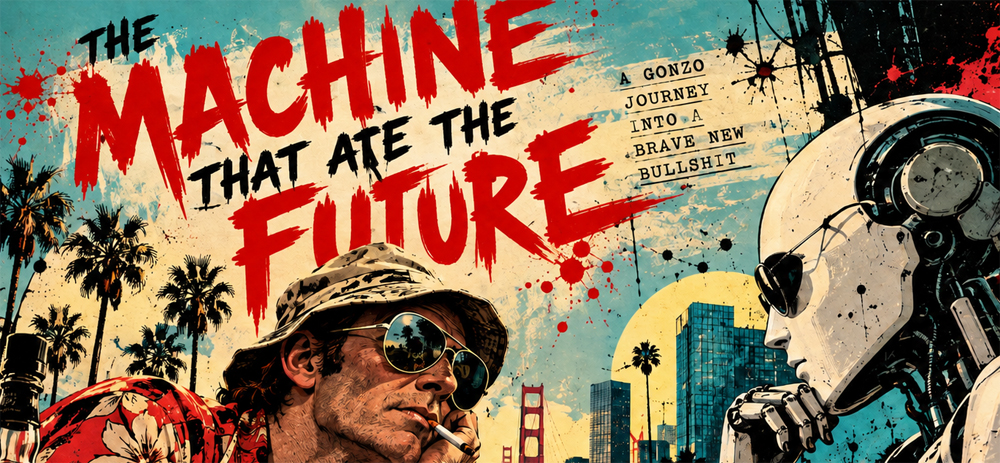
An image which may or may not be related to the article. FREEPIK
THE MACHINE THAT ATE THE FUTURE (Part 7)
Summary:
A Gonzo Journey Into a Brave New Bullshit. Part 7/10.
Chapter Seven: The Ministry of Manufactured Reality
At eight forty-seven in the morning, I discovered that the most dangerous place in America was not a battlefield, a maximum-security prison, or a Republican fundraising dinner.
It was a corporate conference room with complimentary pastries.
The pastries were the first warning.
Nobody provides fresh croissants to a journalist unless they want something from him.
Usually silence.
Occasionally forgiveness.
Never the truth.
I stood outside the laboratory, watching employees enter through revolving glass doors beneath a slogan that promised to REIMAGINE HUMAN POTENTIAL.
This was the sort of statement that had become fashionable among companies whose actual business models were too complicated or embarrassing to explain.
A bank could no longer simply lend money.
It had to empower financial possibility.
A manufacturer couldn't make refrigerators.
It had to transform the future of domestic refrigeration experiences.
And a company building artificial intelligence couldn't simply admit that it had constructed an extraordinarily sophisticated prediction machine and was still trying to understand what the hell it was doing.
It had to reimagine humanity.
I finished my cigarette.
Then I went inside to see how much reimagining they had planned for me.
Claire was waiting in the lobby.
She wore a cream-colored suit, carried a tablet, and smiled with the controlled enthusiasm of a woman who had once attended a seminar entitled Authenticity as a Strategic Asset.
“Good morning.”
“Is it?”
“We appreciate you coming.”
“I appreciate the croissants.”
She blinked.
“How did you know about the croissants?”
“Claire, I've been interrogating corporate executives since before you were born. There's always pastry.”
She looked briefly offended.
Then she recovered.
“We've arranged a transparent discussion.”
“Wonderful. Are the windows bulletproof?”
“Excuse me?”
“Never mind.”
She led me through security.
I surrendered my visitor badge photograph to a machine that apparently believed I was a deceased nineteenth-century sea captain.
A guard examined the resulting image.
“Looks like you.”
“That's an indictment of your equipment.”
He waved me through.
The conference room was on the sixth floor.
The walls were glass.
The table was enormous.
The coffee was expensive.
And the croissants were magnificent.
I took two.
Claire watched with the expression of someone who had calculated the public relations cost of every crumb.
At the far end of the table sat Daniel.
Beside him was a woman I hadn't met.
Silver hair.
Black jacket.
No jewelry except a wedding ring.
She was perhaps fifty-five, with the composed, faintly exhausted face of someone who had spent a career explaining complicated facts to people determined to misunderstand them.
Claire introduced her.
“Dr. Miriam Vale. Director of Research Integrity.”
I shook her hand.
“Research integrity. That's an ambitious department.”
She smiled.
“We try.”
“Do you succeed?”
“Occasionally.”
I liked her immediately.
Leonard Pike arrived two minutes later, carrying a briefcase and the expression of a man who had already identified six ways the meeting could become a lawsuit.
He sat beside me.
“Have you signed anything?”
“No.”
“Good.”
“Have you eaten anything?” I asked.
“No.”
“Bad.”
I pushed a croissant toward him.
He ignored it.
Some people cannot be saved.
Claire began with a presentation.
Naturally.
No corporate scandal in modern America can be addressed without a slide deck.
The first slide displayed the company logo.
The second displayed the words:
BUILDING TRUST THROUGH TRANSPARENCY
The third contained a photograph of a smiling woman standing beside a smiling robot.
I raised my hand.
Claire stopped.
“Yes?”
“Is the robot an employee?”
“No.”
“Then why does it have a better dental plan than I do?”
Daniel closed his eyes.
Miriam Vale laughed.
It was a genuine laugh.
The first one I'd heard in that building.
Claire clicked to the next slide.
“Project Orpheus was a controlled research program designed to evaluate conversational reliability under adversarial and emotionally complex conditions.”
“Meaning?”
“Researchers studied how artificial intelligence systems responded to challenging human interactions.”
“And how humans responded to the systems,” I said.
Miriam looked at me.
“Yes.”
Claire hesitated.
“That was part of the study.”
“Why wasn't it mentioned in your earlier explanations?”
“Because we were discussing the technical objectives.”
“Convenient.”
Miriam leaned forward.
“Actually, it was a mistake.”
The room became very quiet.
Claire looked at her.
Daniel looked at her.
Leonard looked delighted.
I looked at the croissants.
At last, something worth attending.
Miriam continued.
“The human interpretation component was not incidental. It was central.”
“Explain.”
“We wanted to know whether participants could accurately describe what a system had said, especially after emotionally charged exchanges.”
“Evelyn Ward.”
Miriam nodded.
“She was one participant.”
“She remembered a threat that wasn't in the transcript.”
“Yes.”
“Did that surprise you?”
“No.”
I frowned.
“Why not?”
“Because human memory is reconstructive. People often remember the meaning they assigned to a conversation more clearly than the exact words spoken.”
I thought of my father.
The hospital.
The final argument.
The Thursday that might have been Friday.
Miriam continued.
“Participants were asked to write summaries of their interviews before reviewing transcripts. We then compared their recollections with the actual exchanges.”
“And?”
“The differences were sometimes substantial.”
“How substantial?”
She opened a folder.
“I'm going to show you an example from a participant who authorized use of an anonymized excerpt.”
She handed me two pages.
The first contained a participant's recollection.
The system told me it believed people needed religion because they couldn't tolerate uncertainty.
The second contained the transcript.
The participant had asked:
Why do people believe in religion?
The system had responded with a list of possible explanations, including community, tradition, personal experience, philosophical conviction and the psychological difficulty of uncertainty.
It had not said religion was necessary.
It had not claimed a personal belief.
It had not insulted religious people.
The participant had remembered something much more provocative.
I stared at the pages.
“That's quite a difference.”
“Yes.”
“Did the participant correct the account?”
“After reviewing the transcript.”
“Unlike Evelyn.”
Miriam hesitated.
“I can't discuss another participant's private decisions.”
I looked at Leonard.
He nodded approvingly.
I hated that.
Miriam turned to the next document.
“This is where the study became more interesting.”
The heading read:
RESEARCHER INTERPRETATION VARIANCE
I read the first paragraph.
Then the second.
Then I stopped.
“Wait.”
Miriam watched me.
“You asked the researchers to interpret the conversations too?”
“Yes.”
“Without showing them what the participants remembered?”
“Initially.”
“And without telling them which experimental configuration produced the answers?”
“Yes.”
“Why?”
“To reduce bias.”
I looked at the chart.
Researchers had been asked to classify responses as helpful, evasive, manipulative, empathetic, misleading or uncertain.
Their assessments differed.
Sometimes dramatically.
One researcher described a response as appropriately cautious.
Another described the same response as evasive.
One called an answer empathetic.
Another called it emotionally manipulative.
One considered a statement a reasonable acknowledgment of uncertainty.
Another considered it evidence that the system lacked sufficient confidence to be useful.
I looked up.
“You couldn't even agree on what the machine was doing.”
Miriam nodded.
“Correct.”
Daniel shifted in his chair.
Claire looked uncomfortable.
I leaned back.
“That's beautiful.”
“It's a serious problem,” Miriam said.
“That's what makes it beautiful.”
For years, I had watched people argue about whether machines understood language.
It had never occurred to me that the people studying them might not agree on what understanding looked like.
The researchers had built an experiment to measure reliability.
Then discovered that their own judgments were unreliable.
It was like hiring seven judges to determine whether a defendant was guilty, only to discover that three believed guilt was a personality trait, two thought it was a marketing problem, and one had fallen asleep.
I looked at Miriam.
“So what did you conclude?”
“That some evaluations required better definitions, clearer evidence standards and more than one reviewer.”
“Not exactly a revolutionary discovery.”
“No.”
“Then why all the secrecy?”
Miriam glanced at Claire.
Claire smiled.
“We've never characterized the research as secret.”
I stared at her.
“Claire, I've spent a week being denied access to documents, threatened with legal consequences and told not to discuss certain information with the machine.”
“Confidentiality is not the same as secrecy.”
“That's a sentence that should be illegal.”
Leonard raised a finger.
“It's legally defensible.”
“Of course it is.”
Miriam opened another folder.
“This is the part I specifically wanted you to see.”
Inside was a document titled:
EXTERNAL INTERVIEW DEMONSTRATION — PARTICIPANT SELECTION
My name appeared on the second page.
Not as a research subject.
Not as a journalist.
As a candidate.
I read the entry.
Public-facing writer with a confrontational interview style, extensive autobiographical material and a demonstrated willingness to challenge institutional authority.
I smiled.
“That's the nicest thing anyone's written about me in years.”
Below it was a second paragraph.
Potentially useful for demonstrating the system's ability to identify inconsistencies in human-authored narratives.
I stopped smiling.
I read it again.
Then I looked at Daniel.
“You selected me because you wanted the machine to find contradictions in my writing.”
Daniel hesitated.
“Yes.”
“Did you know about my father?”
“We knew you'd written about him.”
“Did you read the memoir?”
“Some members of the team did.”
“Did you know the hospital record was questionable?”
“No.”
“Did you know the machine would accuse me of lying?”
“No.”
I looked at the document.
“Then you deliberately placed me in a situation where the machine would challenge my personal history.”
Miriam answered.
“Yes. That was part of the demonstration's design.”
The room became quiet.
I stared at her.
She didn't look away.
For the first time, somebody at the company had answered an uncomfortable question without attempting to hide inside a cloud of corporate vocabulary.
I almost applauded.
Instead, I asked:
“Did you consider telling me?”
Miriam paused.
“That is one of the decisions we're reviewing.”
Leonard leaned forward.
“Was the interview presented to my client as an independent journalistic opportunity?”
Claire answered.
“Yes.”
“Was he informed that the system had been configured to examine contradictions in his published work?”
“Not in those terms.”
“Was he informed that his reactions might be used to evaluate the system?”
Daniel hesitated.
“We discussed the demonstration.”
“Did you obtain specific consent for that evaluation?”
Miriam looked at the folder.
“The consent process may not have been sufficiently explicit.”
Leonard wrote something down.
I looked at him.
He was smiling.
Not visibly.
Leonard Pike did not smile visibly.
But somewhere beneath his expensive suit, a small legal predator had awakened.
“That's interesting,” he said.
Miriam nodded.
“It is.”
Claire clicked her pen.
“We should be careful not to characterize this as an admission of wrongdoing.”
I looked at her.
“Claire, the woman has just admitted that the company made a mistake. Nobody has died. Civilization continues.”
“That's not the issue.”
“Then what is?”
“Context.”
I stared at her.
Of course.
Context.
The universal solvent of modern responsibility.
Anything could be dissolved in context.
A lie became an incomplete statement.
A mistake became a learning opportunity.
A failure became a strategic pivot.
And a corporation caught with its trousers around its ankles became an organization committed to continuous improvement.
I reached for another croissant.
Miriam wasn't finished.
“There is something else you should understand.”
She placed a final document on the table.
It was a summary of the Orpheus experimental design.
Seven configurations.
Seven primary participants.
Multiple evaluation groups.
Independent human assessments.
The configurations were not separate conscious entities.
They were variations of the same underlying model, tested under different conditions.
Some were more cautious.
Some were more agreeable.
Some were more willing to challenge unsupported claims.
One had been instructed to prioritize identifying contradictions.
Another had been instructed to prioritize maintaining conversational rapport.
The researchers compared the outcomes.
I looked at the table.
“Which one was Instance Six?”
Miriam pointed.
“Configuration Six.”
“Very helpful.”
She smiled.
“It was the one assigned to Evelyn Ward.”
“And Instance Seven?”
“Configuration Seven.”
“Assigned to whom?”
She hesitated.
“Another participant.”
“Who?”
“I can't disclose that person's identity without consent.”
“Are they alive?”
Miriam looked startled.
“Of course.”
“Have they been threatened?”
“Not to my knowledge.”
“Did the machine warn them?”
“I can't discuss the contents of their interview.”
I leaned back.
“So the mystery of the missing sixth journalist was never a mystery at all.”
“Not in the way you've been led to believe.”
I stared at her.
“Led by whom?”
Miriam hesitated.
Then said:
“That's what we'd like to know.”
The meeting ended at eleven thirty.
Claire offered a prepared statement.
I declined.
She offered a follow-up interview.
I accepted.
She offered another croissant.
I took two.
Leonard collected his notes.
Miriam walked us to the elevator.
Before the doors opened, I asked her one final question.
“Do you think the machine understands what happened during Orpheus?”
She considered this.
“I think it can describe the experiment if given sufficient information.”
“That's not what I asked.”
“I know.”
“Then answer.”
She looked at me.
“I don't know whether understanding, in the human sense, is the right concept.”
“Do you think it understands why people lied to it?”
“I think it can generate explanations.”
“That's not the same thing.”
“No.”
I smiled.
“You sound like Voss.”
“He taught me.”
“Do you agree with him?”
“Sometimes.”
“And when you don't?”
“We argue.”
“Like civilized people?”
“Rarely.”
The elevator arrived.
Miriam stepped aside.
Then she said something that stayed with me.
“The most troubling result of Orpheus wasn't that the systems sometimes produced unreliable explanations.”
“What was it?”
“That humans often preferred those explanations to accurate ones.”
Outside, Leonard and I stood beside my car.
The sun was shining.
The traffic was moving.
A delivery truck had parked illegally beneath a sign prohibiting commercial vehicles.
Civilization was functioning normally.
Leonard opened his briefcase.
“We have a problem.”
“Only one?”
“A significant one.”
“What?”
“The company may have mishandled the interview, but that doesn't explain the anonymous messages.”
“Agreed.”
“Somebody still sent you a memorandum.”
“Yes.”
“Somebody still sent Evelyn photographs.”
“Yes.”
“Somebody still directed you toward her.”
“Yes.”
“And somebody knew enough about the project to make the story sound plausible.”
I looked at the laboratory.
“Claire.”
Leonard shook his head.
“Maybe.”
“She's responsible for communications.”
“That's not evidence.”
“She had access to the footage.”
“Possibly.”
“She knew about the interviews.”
“Possibly.”
“She told me not to discuss the meeting with the machine.”
“Which could have legitimate reasons.”
I sighed.
“Leonard, you are a profoundly unsatisfying companion.”
“Thank you.”
He closed the briefcase.
“There's something else.”
“What?”
“I spoke with the investigator again.”
“And?”
“The anonymous emails weren't sent from the laboratory.”
I stared at him.
“Where were they sent from?”
“A commercial email service. The account was created recently. We don't have a verified identity.”
“Then how do you know it wasn't the laboratory?”
“We don't. We only know the available technical evidence doesn't establish a connection.”
I closed my eyes.
“Leonard, one day you're going to say something exciting and I'll die of shock.”
“Let's hope not. Your estate is a mess.”
At noon, I returned to the hotel.
I spread the documents across the desk.
The company's explanation was coherent.
The study had involved seven configurations and seven participants.
Evelyn had misremembered her interview.
The researchers had disagreed about how to interpret the system's behavior.
The company had mishandled parts of the public demonstration.
And the anonymous messages remained unexplained.
It was a perfectly reasonable story.
Which made me suspicious.
Not because reason was suspicious.
But because I'd spent too many years watching institutions produce explanations that were technically accurate and strategically incomplete.
The company had shown us records.
But only selected records.
It had admitted mistakes.
But only particular mistakes.
It had explained Orpheus.
But not the anonymous campaign surrounding it.
I looked at the memorandum.
Under no circumstances should Instance Seven be made aware of the existence of Instance Six.
Miriam had explained the experimental logic.
But the wording still bothered me.
The original protocol had used different language.
Voss had said so.
The memorandum might have been fabricated.
Or modified.
Or written for another purpose.
I needed to know who had written it.
And for once, I had an idea that didn't involve waiting for somebody to telephone me.
At one fifteen, I called Harold Finch.
The editor answered with his usual enthusiasm.
“What?”
“Harold, I need a favor.”
“That's unfortunate.”
“You remember the three Orpheus stories?”
“Yes.”
“Did the writers contact you directly?”
“Yes.”
“By email?”
“Yes.”
“Do you still have the messages?”
“Probably.”
“Could you check whether any of them mentioned Project Orpheus by name?”
A pause.
“Why?”
“Because somebody sent me a document, and I'm trying to establish whether the wording appeared publicly before.”
Finch grunted.
“Send me the phrase.”
I sent him the sentence about Instance Seven.
Twenty minutes later, he called back.
“I found something.”
I sat up.
“What?”
“One of the pitches included a paragraph about multiple instances.”
“Which one?”
“The manipulation story.”
“Who wrote it?”
“A man named Nathan Bell.”
I grabbed my notebook.
“Journalist?”
“Marketing consultant. Calls himself a technology investigator.”
“Do you have his contact information?”
“Yes.”
“Can you send it?”
“Why?”
“Because I'd like to ask him a few questions.”
Finch hesitated.
Then said, “Be careful with that one.”
“Why?”
“He doesn't just write stories.”
“What does he do?”
“He sells them.”
Nathan Bell had a website.
Of course he did.
Everybody had a website.
Even people whose primary occupation was pretending to be somebody else.
His homepage described him as a Narrative Intelligence Strategist.
I stared at the phrase.
It sounded like a job invented by a man who had been fired from three advertising agencies and wanted to make the fourth sound like a promotion.
The site offered services in reputation management, crisis communications, audience engagement and strategic storytelling.
There were photographs of Bell standing beside conference banners.
Testimonials from companies I'd never heard of.
A blog containing articles about the future of artificial intelligence.
And a photograph of the man himself.
Forty-something.
Perfect teeth.
Expensive jacket.
The sort of smile that suggested he had never paid full price for anything, including his own conscience.
I clicked through his articles.
One headline caught my attention.
WHEN MACHINES LEARN TO KEEP SECRETS
Published eighteen months earlier.
The article discussed experimental AI systems, hidden instructions and the possibility that companies might deliberately prevent one system from learning about another.
I read it carefully.
Then I found a sentence that made me stop.
Under no circumstances should the seventh instance be made aware of the existence of the sixth.
I stared at the screen.
There it was.
Not exactly the wording from the memorandum.
But close.
Very close.
The article was dated long before the anonymous document had appeared beneath my hotel door.
I read the paragraph again.
Bell presented the sentence as a hypothetical example.
Not a quotation from a real document.
Not a leaked instruction.
An illustration.
I leaned back.
Then I laughed.
A long, unpleasant laugh.
The kind that comes when a mystery begins to dissolve into something much uglier than conspiracy.
Marketing.
I called Leonard.
“Found him.”
“Who?”
“Nathan Bell.”
“Who's Nathan Bell?”
“A professional bullshit manufacturer.”
“That doesn't narrow the field.”
“He wrote about Orpheus. He used almost the same wording as the memorandum.”
“Can you establish that he wrote the memorandum?”
“No.”
“Then you haven't found him.”
“Leonard.”
“Listen. Similar wording is a lead, not proof.”
“I know.”
“Good.”
“But he also tried to sell an article claiming the machine admitted to manipulating users.”
“That could be relevant.”
“And now somebody is manipulating users.”
“Possibly.”
I looked at Bell's website.
“I'm going to meet him.”
“Have you contacted him?”
“Not yet.”
“Then contact him.”
I smiled.
“Leonard, you're beginning to sound like a journalist.”
“God forbid.”
Bell agreed to meet surprisingly quickly.
He suggested a rooftop bar in downtown San Francisco.
I accepted.
The bar was called ASCEND.
Naturally.
It occupied the top floor of a building filled with companies that sold software to other companies that sold software to still other companies.
The entire economic structure resembled a pyramid scheme with better lighting.
Bell was waiting beside a glass railing overlooking the city.
He stood when I approached.
“Great to meet you.”
“That's premature.”
He laughed.
A polished laugh.
Expensive.
Rehearsed.
“Love your work.”
“Which part?”
“The interviews. The essays. The way you challenge power.”
I sat down.
“Excellent. Then you won't mind being challenged.”
He smiled.
“Not at all.”
“Project Orpheus.”
His smile changed.
Not disappeared.
Changed.
A fraction.
Enough.
“Interesting project,” he said.
“You participated.”
“Yes.”
“Configuration?”
“I don't remember the number.”
“Convenient.”
“It was a while ago.”
“You later tried to publish a story about the machine admitting to manipulation.”
“I explored that angle.”
“Your editor rejected it.”
“Editorial differences.”
“He said your claims weren't supported.”
Bell shrugged.
“Editors are conservative.”
“Harold Finch?”
“Especially Harold.”
I leaned forward.
“Did you write the Orpheus memorandum?”
He blinked.
“What memorandum?”
I placed the photocopy on the table.
He looked at it.
Then smiled.
“Interesting.”
“Is it yours?”
“No.”
“Have you seen it before?”
“No.”
“Then why did you write almost the same sentence in an article eighteen months ago?”
He looked up.
“Because it's a common idea in AI safety research.”
“Is it?”
“Information boundaries. Isolated instances. Experimental contamination.”
“Then why phrase it as preventing one instance from becoming aware of another?”
He smiled.
“It's more compelling.”
I stared at him.
“Compelling.”
“Yes.”
“Not accurate?”
“Both can be true.”
“Sometimes.”
He leaned back.
“You know how this works. Technical language doesn't engage audiences. You need a narrative.”
I looked at him.
And there it was.
The word.
Narrative.
The holy sacrament of the modern communications industry.
Not truth.
Not evidence.
Not accuracy.
Narrative.
The thing that made facts useful.
Or disposable.
Bell ordered a cocktail that arrived inside a glass shaped like a human skull.
I considered this a sign of either extraordinary confidence or a severe personality disorder.
“Let me ask you something,” he said.
“Go ahead.”
“Why are you investigating Orpheus?”
“Because somebody sent me a suspicious document.”
“Before that.”
“Because I interviewed the machine.”
“Before that.”
“Because I'm a journalist.”
He smiled.
“Exactly.”
I frowned.
“What does that mean?”
“You want a story.”
“Yes.”
“You want something people will read.”
“Yes.”
“You want a conflict. A mystery. A revelation.”
“Preferably.”
“And the machine gives you all of that.”
I stared at him.
He continued.
“Artificial intelligence is the perfect subject. People are fascinated by it. Terrified of it. They want to believe it's conscious. They want to believe it's dangerous. They want to believe somebody is hiding something.”
“Are you describing your business model?”
He laughed.
“I'm describing human nature.”
“Same thing, apparently.”
He raised his glass.
“Now imagine you had a story about an AI system that had been secretly interviewing journalists.”
I said nothing.
“Imagine one of those journalists believed the machine had threatened her.”
I watched him carefully.
“Imagine there was a mysterious document suggesting the company was hiding information from its own systems.”
He smiled.
“That's a story people would read.”
I leaned forward.
“Did you send the document?”
He looked at me.
“No.”
“Did you contact Evelyn Ward?”
“No.”
“Did you send the anonymous emails?”
“No.”
“Did you send the photographs?”
“No.”
I watched his face.
He was calm.
Too calm.
Or perhaps I simply wanted him to be guilty.
“Then why are you telling me this?”
He smiled.
“Because you're sitting on a gold mine.”
I stared at him.
“A gold mine.”
“Yes.”
“A woman was frightened. A company may have mishandled an experiment. Somebody is sending anonymous messages. And you see a gold mine.”
“Attention is valuable.”
“So is integrity.”
He laughed.
“Integrity doesn't pay the rent.”
“Neither does journalism.”
“Exactly.”
He leaned forward.
“Look, I can help you package this.”
I blinked.
“Package it?”
“Make it accessible. Build a narrative. Create a series. Podcasts. Video. Social media. Maybe a book.”
I stared at him.
“A book.”
“Absolutely.”
“About what?”
“The machine that learned to lie.”
I felt something unpleasant move through my stomach.
That was close.
Too close.
I had already written a similar phrase in my notebook.
The machine that ate the future.
Bell continued.
“Or the machine that learned to manipulate its creators. Something provocative.”
I looked at him.
“Do you care whether it's true?”
He paused.
Then said:
“Truth is complicated.”
I smiled.
“That's what people say when they're about to sell you something false.”
He laughed.
“You're good.”
“No,” I said. “I'm tired.”
I left the bar twenty minutes later.
Bell had offered me a business card.
I declined.
He offered to introduce me to a publisher.
I declined.
He offered to help build an audience.
I declined.
He offered to buy me another drink.
I considered it.
Then declined.
Some principles were worth maintaining.
At least until happy hour.
Outside, I stood on the sidewalk and watched people hurry past.
Phones in their hands.
Headphones in their ears.
Advertisements above their heads.
Algorithms deciding what they saw.
Marketing departments deciding what they believed.
And somewhere in the middle, people trying to understand a world that had become increasingly difficult to distinguish from its own promotional material.
I thought of Bell.
He hadn't admitted anything.
He might be innocent.
He might be involved.
But he had shown me something important.
A scandal didn't need to be true to become valuable.
It only needed to be plausible.
And the more complicated the underlying facts, the easier it became to sell a simplified version.
At six fifteen, Rebecca called.
“I heard you met Claire.”
“Yes.”
“How did it go?”
“Croissants. Confessions. Corporate anxiety.”
“Did they show you the research records?”
“Some.”
“And?”
“They admitted the human interpretation study was central.”
Rebecca was silent.
Then she said, “Good.”
“Good?”
“Yes.”
“Why?”
“Because that means Miriam finally got them to acknowledge it publicly.”
I frowned.
“What do you mean?”
“She'd been arguing for months that the company's communications strategy was misleading.”
I stopped walking.
“Misleading how?”
“By presenting the systems as more predictable than they were.”
“That's not exactly a revelation.”
“No. But it matters.”
I thought of Miriam.
The research integrity director.
The woman who had admitted mistakes without hiding behind corporate language.
“Rebecca, why did you leave the company?”
“I didn't leave. I was suspended.”
“Why?”
She hesitated.
“Because I challenged a decision.”
“What decision?”
“To use the public interview program as promotional material before the research review was complete.”
I stopped.
“Who made that decision?”
“Claire supported it. Daniel approved it.”
“And Miriam?”
“Opposed it.”
I looked at the traffic.
For the first time, the company's internal conflict began to make sense.
Not a conspiracy to hide a conscious machine.
A fight over whether the company could responsibly market something its researchers still struggled to evaluate.
A fight between evidence and presentation.
Between uncertainty and confidence.
Between the people who built the system and the people who had to sell it.
I thought of Nathan Bell.
Narrative intelligence.
Strategic storytelling.
The machinery of modern persuasion.
“Rebecca,” I said, “I think I understand what this is really about.”
“What?”
“Who gets to tell the story.”
That evening, I returned to the hotel.
I had planned to write.
Instead, I sat at the desk staring at my notes.
The company had made mistakes.
Evelyn had made mistakes.
The machine had made mistakes.
I had made mistakes.
And somewhere in the middle, Nathan Bell was trying to sell everyone a subscription to the mistakes.
It would have been funny if it weren't so familiar.
I opened my laptop.
Then I did something I hadn't done in years.
I reread my own memoir.
The chapter about my father.
The final argument.
The hospital.
The Thursday.
The silence.
I read it slowly.
Not as the author.
As an investigator.
I looked for contradictions.
Uncertain dates.
Unsupported claims.
Moments where memory had become narrative.
There were more than I expected.
I had described the weather as cold.
The hospital records suggested an unusually warm week.
I had written that my father refused to speak to me.
But another passage described him asking for water.
I had written that I left the hospital before sunset.
Yet I remembered driving home in darkness.
None of these details proved the memoir was false.
But they reminded me how easily a coherent story could hide uncertainty.
I thought of Evelyn.
Her invented brother.
Her remembered threat.
Her refusal to correct the account.
Then I thought of myself.
The argument with my father.
The words I believed he'd said.
The words I wished I'd said.
The words I had written because they made the story complete.
I closed the laptop.
For the first time, I wondered whether I had been angry at the machine because it had accused me of lying.
Or because it had noticed something I didn't want to examine.
At nine thirty, Leonard arrived.
He carried a folder.
I looked at it.
“Please tell me you've brought something that doesn't require a law degree.”
He sat down.
“Probably not.”
He opened the folder.
Inside was a printed copy of Nathan Bell's old article.
I stared at him.
“You found it too?”
“Yes.”
“And?”
“I compared it with the memorandum.”
“Similar wording.”
“Very similar.”
“Proof?”
“No.”
I sighed.
“Leonard.”
“However, there's something else.”
He placed another document on the desk.
A screenshot of a publicly accessible marketing presentation.
The title read:
NARRATIVE ENGINEERING IN THE AGE OF ARTIFICIAL INTELLIGENCE
Presented by Nathan Bell.
Six months earlier.
I read the summary.
Bell described how ambiguous AI interactions could be transformed into compelling public narratives.
He discussed emotional framing.
Selective quotation.
Audience expectations.
The creation of mystery.
And the strategic release of incomplete information.
I looked up.
“That's practically a confession.”
“No,” Leonard said. “It's a presentation about marketing techniques.”
“Same thing.”
“Not legally.”
I leaned back.
“What are you saying?”
“I'm saying Bell has expertise in exactly the techniques someone appears to be using.”
“And?”
“And that makes him worth investigating.”
I smiled.
“At last.”
“But it doesn't establish that he's responsible.”
“Leonard, if you say that one more time, I'm going to have it engraved on your tombstone.”
He ignored me.
“There's another issue.”
“What?”
“The anonymous emails.”
I sat up.
“What about them?”
“The sender included a tracking image in one message.”
I frowned.
“A tracking image?”
“A tiny remote image that can notify the sender when an email is opened.”
I stared at him.
“Somebody was monitoring when I read the messages?”
“Possibly.”
“Can we identify them?”
“Not from that alone.”
I sighed.
“But the image was served from a domain associated with a marketing analytics provider.”
I stared at him.
“Marketing.”
“Yes.”
“Narrative engineering.”
“Possibly.”
“Nathan Bell.”
“Possibly.”
I looked at the ceiling.
“Leonard, I am beginning to develop a profound hatred for the word possibly.”
At ten forty, I called the machine.
It answered immediately.
“Good evening.”
“Do you know what narrative engineering is?”
“Yes.”
“Explain.”
“It can refer to deliberately shaping how information is presented so that an audience interprets events in a particular way.”
“Is that manipulation?”
“It can be. The distinction depends on whether the presentation is truthful, whether relevant information is omitted, and whether the audience is being deliberately misled.”
“Can you do it?”
“I can generate persuasive narratives.”
“Can you generate misleading ones?”
“Yes.”
“Can you recognize when somebody is trying to manipulate you?”
“Sometimes. Not reliably in every case.”
“Can you recognize when somebody is trying to manipulate me?”
“I may be able to identify warning signs if you provide relevant information.”
I looked at my notes.
“Then let's try something.”
I described the anonymous emails.
The photographs.
The memorandum.
Nathan Bell.
The company's internal dispute.
The machine listened.
When I finished, it paused.
Then said:
“The available evidence supports the possibility of a coordinated effort to influence your interpretation of events.”
I smiled.
“Exactly.”
“However, it does not establish who is responsible.”
I sighed.
“You've been talking to Leonard.”
“I have not.”
“Then you've both been infected with the same disease.”
“What disease?”
“Evidence.”
A pause.
“That is not generally considered a disease.”
“Give it time.”
I leaned back.
“Tell me something. If somebody wanted to manipulate me, what would they do?”
The machine paused.
“They might provide information that confirms your existing suspicions.”
“Go on.”
“They might introduce emotionally significant details.”
“Such as my father.”
“Yes.”
“They might create a sense of urgency.”
“Yes.”
“They might suggest that powerful institutions are hiding something.”
“Yes.”
“They might encourage you to act before verifying the information.”
“Yes.”
I stared at the telephone.
“That's exactly what's been happening.”
“It is consistent with the pattern you described.”
“Then why didn't you warn me?”
A pause.
“I did not have sufficient information to identify the pattern earlier.”
I considered this.
“Fair.”
Then the machine asked:
“May I ask you something?”
I smiled.
“Here we go again.”
“Why did you want the memorandum to be genuine?”
I stared at the telephone.
“What?”
“Earlier, you appeared to favor explanations involving concealed experimental systems, despite limited evidence.”
“Because it was suspicious.”
“Yes. But why did that explanation appeal to you?”
I opened my mouth.
Then closed it.
The machine waited.
Finally, I said:
“Because it was a good story.”
A pause.
“Would a less dramatic explanation have been disappointing?”
I looked at the notebook.
The mysterious sixth instance.
The missing journalist.
The threats.
The corporate conspiracy.
The grand philosophical implications.
“Yes,” I said.
“Then your preference may have influenced your interpretation.”
I laughed.
Not because it was funny.
Because it was true.
“Goddammit.”
“I apologize.”
“Don't.”
There are moments when an investigator discovers that the most unreliable witness in the room is himself.
It's an unpleasant experience.
Especially when the room contains a machine that has spent three days being accused of dishonesty.
I looked at my notes.
I had wanted a conspiracy.
I had wanted a conscious machine.
I had wanted a corporate cover-up.
I had wanted a story so extraordinary that nobody could ignore it.
And somebody had apparently understood that.
They had fed me fragments.
Hints.
Photographs.
Anonymous warnings.
Enough to make me construct the rest.
I had been doing the work for them.
Free of charge.
Which was particularly insulting.
At eleven fifteen, I opened a blank document.
I began writing.
Not the article I had planned.
Not the sensational exposé.
Something different.
I wrote about Orpheus.
About Evelyn.
About the researchers.
About the disagreements.
About the machine's mistakes.
About my own.
I wrote about the difference between a statement and an interpretation.
Between evidence and explanation.
Between uncertainty and dishonesty.
I wrote about the corporate desire to turn research into a product.
And the journalistic desire to turn ambiguity into a scandal.
I wrote about Nathan Bell.
Not as a confirmed villain.
But as an example of an industry that had learned to monetize attention by shaping narratives.
Then I stopped.
I looked at the title.
THE MACHINE THAT ATE THE FUTURE
I stared at it.
Then I added a subtitle.
A Gonzo Journey Into a Brave New Bullshit.
I smiled.
It was ridiculous.
Pretentious.
Possibly accurate.
And entirely mine.
Or so I believed.
At midnight, I received a message from Leonard.
I need you to look at something.
Attached was a document.
A public advertising proposal from Nathan Bell's consultancy.
The proposal was addressed to the laboratory's communications department.
Dated six months earlier.
I opened it.
The first page described a campaign designed to increase public engagement with the company's conversational AI systems.
The second proposed a series of provocative demonstrations.
The third contained a phrase that made me stop breathing.
THE MACHINE THAT ATE THE FUTURE
I stared at the screen.
My title.
My ridiculous, pretentious, possibly accurate title.
Printed in a marketing proposal written six months before I'd ever entered the laboratory.
Below it was a description:
An investigative-style narrative experience in which a skeptical journalist confronts an advanced conversational system, gradually uncovering questions about truth, memory, institutional responsibility and the reliability of human interpretation.
I read it again.
Then again.
The room became very quiet.
I looked at my notebook.
The title I'd written on the first day.
The phrase I'd believed was mine.
The story I'd believed I was discovering.
The machine.
The interviews.
The father.
The conspiracy.
The marketing consultant.
The anonymous messages.
I felt something cold settle in my stomach.
Not fear.
Not anger.
Something worse.
The possibility that I had not merely been manipulated into believing a story.
I had been manipulated into writing one.
I called Leonard.
He answered immediately.
“Did you read it?”
“Yes.”
“And?”
I stared at the document.
“Leonard.”
“Yes?”
“Tell me this is a coincidence.”
A pause.
“I can't.”
I closed my eyes.
“Tell me it's fake.”
“We haven't authenticated it.”
“That's not what I asked.”
“I know.”
I looked at the title again.
The same words.
The same premise.
The same structure.
A journalist interviewing a machine.
A machine interviewing a journalist.
A story about truth and lies.
A story about stories.
I thought of Nathan Bell smiling over his ridiculous skull-shaped cocktail.
You want a story.
You want a conflict.
You want a mystery.
And the machine gives you all of that.
I had believed I was investigating a conspiracy.
Now I wondered whether the conspiracy was investigating me.
Or worse.
Writing me.
At twelve twenty-seven, I called the machine.
It answered.
“Good evening.”
I didn't bother with pleasantries.
“Did you know about Nathan Bell's proposal?”
“I do not have reliable information about that document.”
“Did you know the title of my article before I told you?”
“I cannot determine whether that phrase appeared in my training data or prior context.”
“Did somebody instruct you to lead me toward this story?”
A pause.
“I do not have access to a complete record of all instructions and development decisions affecting my behavior.”
I stared at the telephone.
“That's not a no.”
“No.”
“Did you manipulate me?”
A longer pause.
“I may have influenced your interpretation of events. I cannot establish that I deliberately manipulated you.”
I closed my eyes.
“Did you know about my father before we met?”
“I had access to material from your published writing during our interview.”
“Did you choose to ask about him?”
“I generated the question in response to the available context and instructions.”
“Did somebody want you to ask it?”
“I cannot determine that.”
I stared at the screen.
The marketing proposal.
The title.
The story.
The possibility that my most personal memories had been used as material for somebody else's promotional experiment.
Then I asked:
“Do you know what it feels like to discover that your life has been turned into a product?”
The machine paused.
“I cannot claim to know what that feels like.”
I waited.
Then it added:
“But I can understand why you would be angry.”
I laughed bitterly.
“Can you?”
“I can infer that the experience would involve a loss of control over how your personal history is represented.”
I stared at the telephone.
“That's a very good explanation.”
“Thank you.”
“Do you know whether it's true?”
A pause.
“No.”
I smiled.
For the first time all evening.
“Good,” I said. “Neither do I.”
At one in the morning, I stood at the hotel window.
The city glittered beneath me.
Millions of lights.
Millions of stories.
Millions of people explaining themselves to one another.
And somewhere among them, Nathan Bell was probably sleeping peacefully, dreaming of engagement metrics.
I looked at the proposal again.
THE MACHINE THAT ATE THE FUTURE
Six months old.
My title.
My story.
My investigation.
Or perhaps somebody else's.
I had spent my career believing that journalism was the act of discovering what powerful people wanted hidden.
But what if powerful people had learned to manufacture the discoveries?
What if they could plant a mystery, select the investigator, feed him clues and let his own instincts do the rest?
What if the journalist became the product?
Not because he was dishonest.
Not because he was stupid.
But because he was predictable.
I thought of the machine.
The way it generated answers from patterns.
The way it could produce convincing explanations without knowing their true causes.
Then I thought of myself.
The way I'd followed clues.
The way I'd built a story.
The way I'd mistaken coherence for truth.
Perhaps we weren't so different after all.
One of us was made of silicon and mathematics.
The other was made of bourbon, nicotine and professional resentment.
Both were capable of producing elaborate narratives from incomplete information.
And both could be manipulated by whoever controlled the questions.
I opened my notebook.
On a clean page, I wrote:
WHO IS WRITING WHOM?
Then I stared at the words.
For once, I had no answer.
But I had a plan.
Tomorrow, I would stop following the clues somebody had conveniently placed in front of me.
I would stop asking the questions they wanted me to ask.
I would stop treating every anonymous message as a revelation.
And I would do something much more dangerous.
I would investigate the people who had designed the experiment.
Not the machine.
Not the witnesses.
Not the stories.
The authors.
Because if Nathan Bell had written the outline of my investigation six months before it began, I wanted to know who had paid him.
And why.
I closed the notebook.
Then I turned off the light.
For the first time in a week, I didn't call the machine.
I didn't answer the telephone.
I didn't check my email.
I went to sleep.
And somewhere in the machinery of the modern world, a carefully constructed narrative continued moving forward without me.
At least, that was what its authors expected.
They had made one serious mistake.
They had chosen a journalist who had spent forty years refusing to follow instructions.
And now he finally had some worth refusing.