 muppazine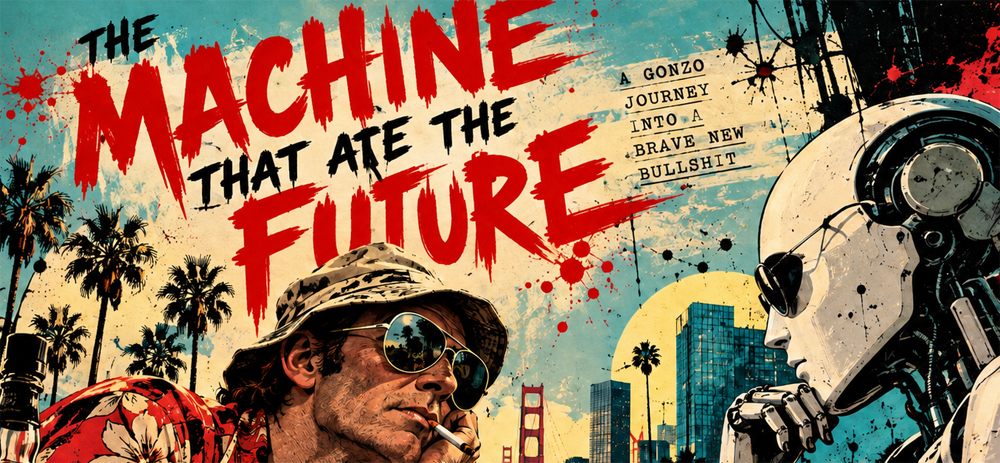
An image which may or may not be related to the article. FREEPIK
THE MACHINE THAT ATE THE FUTURE (Part 8)
Summary:
A Gonzo Journey Into a Brave New Bullshit. Part 8/10.
Chapter Eight: The Architects of the Accident
At nine in the morning, I committed an act of rebellion so profound that it would have terrified every advertising executive in California.
I turned off my telephone.
Not silent mode.
Not airplane mode.
Off.
A complete severance from the electronic nervous system that had spent the previous week feeding me anonymous warnings, corporate invitations, synthetic conversations and enough manufactured urgency to power a medium-sized American election.
The screen went black.
For several seconds, nothing happened.
No alarms.
No helicopters.
No men in dark suits descending from the ceiling.
The world continued.
It was an extraordinary discovery.
I celebrated by ordering breakfast.
The waitress at the diner was named Gloria.
She was approximately sixty, wore enormous turquoise earrings and had the disposition of a woman who had survived three husbands, two recessions and forty years of customers who believed ordering coffee constituted a meaningful personal achievement.
“What'll it be, sweetheart?”
“Eggs. Bacon. Coffee. And whatever you have that isn't connected to the internet.”
She looked at me.
“Toast?”
“Perfect.”
She wrote it down.
“Rough night?”
“I'm being manipulated by a multinational technology company.”
She nodded.
“Everybody is, honey. You want hash browns?”
I did.
Gloria possessed a more sophisticated understanding of modern civilization than most of the people I'd interviewed at the laboratory.
She also understood breakfast.
Two qualifications that ought to have made her president.
I had spent the night thinking about Nathan Bell's marketing proposal.
THE MACHINE THAT ATE THE FUTURE.
My title.
His title.
Six months apart.
Either the universe had developed an unusually aggressive sense of humor, or somebody had arranged for me to walk into a story that had already been written.
I wanted to believe the second explanation.
Which was precisely why I had to be careful.
The temptation was magnificent.
A corporation secretly manipulating a journalist.
An artificial intelligence programmed to uncover his personal contradictions.
A mysterious woman claiming to have been threatened.
A former researcher warning against false memories.
Anonymous documents.
A marketing consultant who sold conspiracies by the yard.
It was a story so beautifully constructed that I could almost hear the film rights being negotiated.
And that was the problem.
Reality rarely arrived with such excellent pacing.
Reality was usually late, poorly dressed and missing three important documents.
I took out my notebook.
On the first page, I wrote:
STOP BEING THE AUDIENCE.
Then, beneath it:
FIND THE CONTRACT.
At ten fifteen, I arrived at Leonard Pike's office.
It occupied the nineteenth floor of a building that looked expensive enough to have its own foreign policy.
Leonard was waiting behind a desk large enough to conduct a minor naval engagement.
He examined my face.
“You look terrible.”
“Thank you.”
“Have you been drinking?”
“Coffee.”
“Anything else?”
“Last night.”
He sighed.
“What do you want?”
“The contract.”
“Which contract?”
“Nathan Bell's contract with the laboratory.”
Leonard leaned back.
“We don't know whether he had one.”
“Then let's find out.”
“How?”
“Ask.”
“Whom?”
“The company.”
“They may decline.”
“Then ask somebody else.”
“Who?”
“The people who paid him.”
Leonard stared at me.
“You're suggesting we follow the money.”
“Yes.”
“That's a surprisingly traditional investigative technique.”
“I've decided to try journalism.”
He looked genuinely pleased.
It was disturbing.
Leonard had already done some preliminary research.
Bell's consultancy was called Narrative Dynamics Group.
A name so devoid of meaning that it could have been generated by a machine trained exclusively on failed business-school presentations.
The company had three employees.
Bell.
A creative director.
And a woman responsible for accounts and administration.
Its website listed clients from technology, finance and political communications.
Some were real.
Some were suspiciously vague.
One appeared to be a cryptocurrency exchange that had ceased operating after its founder moved to a country without an extradition treaty.
Leonard opened a public corporate filing.
“Bell's company was paid by a subsidiary of the laboratory's parent organization.”
I leaned forward.
“How much?”
“The filing doesn't establish the amount.”
“For what?”
“Communications consulting.”
“When?”
“Last year.”
I smiled.
“At last.”
Leonard raised a finger.
“Careful.”
“Oh, for God's sake.”
“This establishes a business relationship. It doesn't establish that Bell's proposal was approved.”
“Then we find the approval.”
“Exactly.”
I stared at him.
“Leonard, this is the first time you've ever said exactly to me.”
“Don't become sentimental.”
We needed someone who knew the company's procurement system.
I suggested Rebecca.
Leonard objected.
“She's suspended. We shouldn't encourage her to access restricted information.”
“Then we'll ask what she knows from her own experience.”
“That is acceptable.”
“Wonderful. I'll inform the Nobel committee.”
We met Rebecca at a public park.
She arrived carrying a paper bag of pastries.
I began to suspect the entire technology industry was secretly controlled by the French baking establishment.
“Did the company hire Nathan Bell?” I asked.
She looked surprised.
“Bell?”
“Yes.”
“Why?”
“Because he's apparently been writing my life story.”
I showed her the proposal.
She read it.
Her expression changed.
“Where did you get this?”
“Leonard.”
“Where did Leonard get it?”
“Public marketing materials.”
She read the title again.
Then she shook her head.
“I remember this.”
I leaned forward.
“Tell me.”
“It was part of a proposed public engagement campaign.”
“Approved?”
“No.”
“Rejected?”
“Not exactly.”
“Rebecca, you're beginning to sound like the company.”
She looked irritated.
“The proposal was circulated. Several people reviewed it. I don't know whether the entire campaign was formally approved.”
“Who reviewed it?”
“Claire. Daniel. Some people in product marketing.”
“Miriam?”
“Yes.”
“What did she think?”
“She hated it.”
I smiled.
“Excellent woman.”
Rebecca continued.
“The proposal suggested using a real journalist to create a serialized investigation around the system.”
“That's me.”
“Possibly.”
“Rebecca.”
“It didn't name you.”
“Fine. Go on.”
“The idea was to let the journalist challenge the system, then allow the system to challenge the journalist. The resulting conversations would generate attention.”
“By manufacturing a mystery.”
“By creating an engaging demonstration.”
I stared at her.
She sighed.
“That's how they described it.”
I placed the proposal on the park bench.
“Did the company hire Bell to execute it?”
Rebecca hesitated.
“I don't know.”
“Did they use any part of his idea?”
“Yes.”
I stopped.
“What?”
“The public interview format.”
I stared at her.
“Who decided that?”
“Daniel's team.”
“And the title?”
“I don't know.”
“And the anonymous messages?”
“I don't know.”
“And Evelyn Ward?”
“She wasn't part of the public demonstration.”
I leaned back.
The situation was becoming clearer.
And more irritating.
The company had received a marketing proposal.
It had apparently borrowed at least one element.
It had selected me.
It had arranged the interview.
But the anonymous campaign might have been somebody else's work.
Or it might have been part of the original plan.
We still didn't know.
I looked at Rebecca.
“Why didn't you tell me about Bell?”
“Because I didn't know he was relevant.”
“Didn't you recognize the title?”
“I hadn't seen the proposal in months.”
“That's convenient.”
Her expression hardened.
“Don't.”
I stopped.
She looked directly at me.
“I've lost access to my job. I've spent days trying to help you understand what happened. And every time I can't answer something, you treat it like evidence that I'm hiding something.”
I opened my mouth.
Then closed it.
She was right.
Again.
It was becoming an epidemic.
“I'm sorry,” I said.
She looked surprised.
So was I.
At noon, Leonard arranged a meeting with Miriam Vale.
Not at the laboratory.
At a small restaurant near the waterfront.
Miriam arrived without a lawyer.
This struck Leonard as either admirable or clinically insane.
She ordered tea.
I ordered whiskey.
The waiter looked at the clock.
I looked at him.
He brought the whiskey.
Civilization survived another test.
Miriam examined the marketing proposal.
“Yes,” she said. “I remember it.”
“Did you approve it?”
“No.”
“Why?”
“Because it blurred the distinction between research and entertainment.”
I leaned forward.
“Explain.”
“The proposal treated uncertainty as a narrative device.”
“Isn't it?”
“In fiction, certainly. In public communication about a technology people may rely on, uncertainty is something you have to describe accurately.”
“And Bell wanted to make it mysterious.”
“Yes.”
“Did the company reject the proposal?”
Miriam hesitated.
“The research integrity group recommended against adopting the campaign.”
“That's not what I asked.”
“I know.”
She looked at Leonard.
Then back at me.
“Some elements were later incorporated into the public interview program.”
I stared at her.
“Despite your objections.”
“Yes.”
“Who approved that?”
“Daniel.”
I smiled grimly.
“Finally. A name.”
Miriam raised her hand.
“Don't make him the villain of a story you haven't finished investigating.”
I frowned.
“Why not?”
“Because Daniel was trying to demonstrate a product. I disagreed with the decision, but disagreement is not evidence of malice.”
I stared at her.
“You researchers are ruining journalism.”
She smiled.
“We're trying.”
Miriam continued.
“The original proposal was supposed to be a controlled demonstration. A journalist would interview the system. Then the system would ask questions based on the journalist's published work.”
“That's exactly what happened.”
“Yes.”
“Did Bell write the questions?”
“No.”
“Did Daniel?”
“No.”
“Did Claire?”
“No.”
“Then who?”
“The system generated them under instructions developed by the research and product teams.”
“Instructions based on Bell's proposal?”
“Some elements of the format were similar.”
I stared at her.
“Did anyone deliberately select my father's death as a subject?”
Miriam hesitated.
“I've reviewed the relevant records. I found no evidence of that.”
I looked at her.
“Are you certain?”
“I'm certain about what the records show. I can't prove that no one discussed it elsewhere.”
I thought about the memoir.
The hospital record.
The machine's accusation.
The correction.
For days, I'd believed somebody had deliberately targeted the most painful part of my life.
Now it seemed possible that the machine had simply encountered the contradiction while examining my published work.
That didn't make the experience less painful.
But it changed the nature of the accusation.
I had wanted someone to blame.
The evidence wasn't cooperating.
Leonard opened his notebook.
“Dr. Vale, did Nathan Bell receive payment for the proposal?”
“Yes.”
I sat up.
“How much?”
“I don't know the exact amount.”
“Was he retained for the campaign?”
“No.”
“Are you certain?”
“To the best of my knowledge, yes.”
“Then why did the company use his idea?”
Miriam looked uncomfortable.
“Because the proposal had been circulated internally. Some people considered the interview format useful.”
“Without hiring him?”
“Yes.”
I stared at her.
“That's rather unpleasant.”
“Yes.”
“Did Bell know?”
“I don't know.”
“Could he have been angry?”
“Possibly.”
I looked at Leonard.
He looked at me.
Neither of us spoke.
Miriam noticed.
“Don't turn that into a conclusion.”
I sighed.
“Does everybody in this town have Leonard's telephone number?”
At one forty-five, I did something that would have horrified my younger self.
I went to see Nathan Bell again.
Not because I trusted him.
Not because I liked him.
But because he was the one person who might have had a motive to turn a rejected marketing proposal into a public embarrassment.
This time, I didn't arrange a glamorous rooftop meeting.
I went to his office.
It was on the second floor of a building above a yoga studio and a shop selling artisanal dog treats.
The sign on the door read:
NARRATIVE DYNAMICS GROUP
Below it:
We Shape What Matters.
I stared at the slogan.
Then knocked.
A young woman opened the door.
“Can I help you?”
“I'm looking for Nathan Bell.”
“Do you have an appointment?”
“No.”
“What's this regarding?”
“An unpaid story.”
She looked confused.
“Are you a client?”
“Not voluntarily.”
She disappeared.
A moment later, Bell emerged.
He was wearing a white shirt with the sleeves rolled up.
The universal costume of a man who wanted people to believe he worked harder than he did.
“Well, look who it is.”
“Hello, Nathan.”
“Come in.”
He led me into an office decorated with framed magazine covers, marketing awards and a photograph of himself shaking hands with a man whose name I didn't recognize.
I sat down.
Bell smiled.
“What can I do for you?”
“You can tell me why the laboratory used your proposal without hiring you.”
The smile vanished.
Not entirely.
But enough.
Bell leaned back.
“Who told you that?”
“Does it matter?”
“Yes.”
“Then I won't tell you.”
He stared at me.
I smiled.
“Annoying, isn't it?”
He sighed.
“Look. We pitched a campaign. They liked parts of it. Then they decided to handle the project internally.”
“And you weren't paid?”
“We were paid for the proposal.”
“But not for implementation.”
“Correct.”
“Did that upset you?”
He laughed.
“Wouldn't it upset you?”
“Depends. Did they steal your idea?”
“That's a complicated question.”
“Excellent. I specialize in those.”
He stood and walked to the window.
“They wanted a provocative public demonstration. We gave them one. A journalist confronting an AI. The AI confronting the journalist. A story about truth and deception.”
“And they used it.”
“Yes.”
“Without you.”
“Yes.”
I watched him.
“Did you send me the Orpheus memorandum?”
He turned.
“No.”
“Did you send Evelyn Ward the photographs?”
“No.”
“Did you send the anonymous emails?”
“No.”
“Did you arrange for somebody else to do it?”
His expression hardened.
“No.”
I waited.
Then asked:
“Did you know my name before the company invited me?”
A pause.
“Yes.”
I felt the room tighten.
“Why?”
“Because you were on our candidate list.”
I stared at him.
“What candidate list?”
Bell hesitated.
Then walked to his desk.
He opened a drawer.
Took out a folder.
And placed it in front of me.
The folder contained a list of potential journalists.
Twelve names.
Some famous.
Some obscure.
Some dead.
I was number four.
Beside my name was a short description.
Confrontational style. Strong autobiographical material. High likelihood of emotionally engaging exchange.
I read it twice.
“Who wrote this?”
“Our research team.”
“Your marketing research team?”
“Yes.”
“Did you read my memoir?”
“Someone did.”
“Did you identify my father's death as useful material?”
Bell hesitated.
I stared at him.
“Answer.”
He looked away.
“Yes.”
The room became very quiet.
I looked at the folder.
Then at him.
“You selected me because of my father.”
“No. We considered you because of your writing.”
“My writing about my father.”
“Among other things.”
I stood up.
Bell raised his hands.
“Look, this is standard audience research.”
I stared at him.
“Standard?”
“Yes.”
“You identified a man's grief as an engagement opportunity.”
He looked uncomfortable.
“That isn't how I'd phrase it.”
“How would you phrase it?”
He hesitated.
Then said:
“Emotionally resonant source material.”
I laughed.
A horrible laugh.
The kind that comes when somebody has finally found a phrase so obscene that ordinary profanity becomes inadequate.
“Emotionally resonant source material.”
Bell said nothing.
I looked at the folder.
My father's death.
My memoir.
My private history.
Reduced to a bullet point in a marketing proposal.
I felt a sudden urge to hit him.
Not a theatrical urge.
Not the sort of impulse one describes later as righteous anger.
A simple, ugly, physical desire to break something.
I didn't.
Instead, I sat down.
And asked the question that mattered.
“Did you tell the laboratory to use my father?”
Bell hesitated.
“We suggested that the system engage with autobiographical material.”
“Did you specifically recommend the memoir?”
“Yes.”
“Did you recommend the hospital record?”
“No.”
“Did you know about the discrepancy?”
“No.”
I stared at him.
He looked genuinely uncomfortable.
For the first time, the man who sold stories seemed to understand that he had become a character in one.
I took out my notebook.
“Who wrote the anonymous messages?”
Bell shook his head.
“I don't know.”
“Who sent the photographs?”
“I don't know.”
“Who wrote the memorandum?”
“I don't know.”
I watched him.
Then asked:
“Did you use the phrase ‘Instance Seven should not be made aware of Instance Six’ in your proposal?”
“Yes.”
“Why?”
“Because it sounded dramatic.”
“Was it based on an actual instruction?”
“No.”
I stopped.
“What?”
“It was a hypothetical line. An example of how you could frame a story around hidden information.”
I stared at him.
“So you invented it.”
“Yes.”
“Then somebody turned it into a fake memorandum.”
“Apparently.”
“Did you do that?”
“No.”
I looked at him.
“Who had access to the proposal?”
“Several people.”
“Names.”
He hesitated.
Then gave me three.
Claire.
Daniel.
And a woman named Sophie Mercer.
I wrote the name down.
“Who is Sophie Mercer?”
Bell looked surprised.
“She was our creative director.”
“Was?”
“She left.”
“When?”
“Four months ago.”
“Why?”
He shrugged.
“Disagreements.”
“What kind?”
“Creative differences.”
I stared at him.
“Nathan, I've spent forty years listening to people explain disasters with the phrase creative differences. It's never been true.”
He smiled weakly.
“She thought the laboratory had stolen our work.”
“And you didn't?”
“I thought it was business.”
“What did she think?”
He hesitated.
“That we should make them regret it.”
At four twenty, I called Leonard.
“I have a name.”
“Whose?”
“Sophie Mercer.”
“Who is she?”
“Former creative director at Narrative Dynamics Group.”
“And?”
“She had access to the proposal. She was angry about the laboratory using it.”
“Evidence?”
“Bell says so.”
“That's a lead.”
“I know.”
“Do we have contact information?”
“Not yet.”
“I'll look.”
I hung up.
Then turned my telephone back off.
Not because I was afraid of another mysterious message.
Because I had finally learned the difference between receiving information and investigating it.
The first required a screen.
The second required shoes.
And mine were beginning to hurt.
Sophie Mercer lived in a modest apartment in Berkeley.
Leonard found a business address through public records, but it was outdated.
A former colleague provided a professional contact number.
I called.
No answer.
I left a message.
No response.
I sent an email.
Nothing.
For two hours, I waited.
Then I did what any responsible journalist would do.
I went to a bar.
The bar was called THE LAST WORD.
This struck me as an encouraging sign.
It was small, dark and smelled of whiskey, old wood and conversations that should never have been recorded.
I ordered a drink.
Then another.
At seven thirty, my telephone vibrated.
I had forgotten to turn it off.
A message from an unknown number.
You want to talk to Sophie Mercer.
I stared at it.
Then smiled.
At last.
The anonymous machinery was moving again.
A second message appeared.
Stop looking for her.
I laughed.
Not quietly.
The bartender looked at me.
“Everything okay?”
“Perfect.”
A third message arrived.
She doesn't know what she's involved in.
I stared at the screen.
Then typed:
Neither do I. That's why I'm asking questions.
The reply came almost immediately.
You're making a mistake.
I smiled.
Then wrote:
Which one? I've made several.
No reply.
I finished my drink.
Then called Leonard.
“Another anonymous message.”
“What did it say?”
“Stop looking for Sophie Mercer.”
“Did you respond?”
“Yes.”
He sighed.
“Of course you did.”
“I was polite.”
“That worries me more.”
I looked at the screen.
“Leonard, I think somebody is getting nervous.”
“Maybe.”
“Or somebody wants you to think they're nervous.”
I smiled.
“Now you're getting it.”
At eight fifteen, Sophie Mercer called.
Her voice was low.
Tired.
Angry.
“You've been asking about me.”
“Yes.”
“Why?”
“Because your former employer says you were angry about a marketing proposal.”
A pause.
“Nathan talks too much.”
“Occupational hazard.”
“What do you want?”
“To ask whether you sent me a forged Orpheus memorandum.”
Silence.
Then:
“No.”
“Did you send photographs to Evelyn Ward?”
“No.”
“Did you send anonymous emails?”
“No.”
I waited.
Then asked:
“Do you know who did?”
A long pause.
“Yes.”
I sat up.
“Who?”
She hesitated.
Then said:
“Not over the phone.”
We met at a parking garage.
Not a laundromat.
Not a rooftop bar.
Not a corporate conference room.
A parking garage.
I was beginning to suspect that California had run out of ordinary places for people to discuss extraordinary things.
Sophie Mercer stood beside a red hatchback.
She was in her thirties, with short dark hair, a leather jacket and the expression of someone who had spent the last six months regretting a decision that had initially seemed clever.
She looked at me.
“You came alone?”
“Yes.”
“Where's your lawyer?”
“Probably charging me for not being here.”
She didn't smile.
“Did you bring a recorder?”
“Yes.”
“Turn it off.”
I hesitated.
Then did.
“Now tell me,” I said.
She looked around.
Then said:
“I wrote the campaign.”
I stared at her.
“The Orpheus campaign?”
“Yes.”
“The proposal?”
“Yes.”
“The fake memorandum?”
She hesitated.
Then nodded.
I felt my stomach tighten.
“Why?”
“Because I wanted to prove something.”
“What?”
“That people would believe anything if you gave them the right story.”
I stared at her.
She looked away.
“It started as a demonstration.”
“A demonstration of what?”
“Narrative engineering.”
I closed my eyes.
Of course.
The goddamn phrase again.
She continued.
“Nathan wanted to sell the laboratory a campaign. I developed a concept where a journalist would investigate an AI system, discover mysterious clues and gradually realize that the investigation itself had been shaped by the people behind the technology.”
I stared at her.
“That's my story.”
“Yes.”
“Six months ago.”
“Yes.”
“Before I ever met the machine.”
“Yes.”
I looked at her.
“Did you select me?”
“You were one of the candidates.”
“Because of my father.”
She hesitated.
“Partly.”
I felt the old anger return.
She continued quickly.
“But I didn't choose you. The laboratory did.”
“Then why did you send the memorandum?”
She looked down.
“Because they used our idea.”
“And didn't pay you?”
“They paid Nathan for the proposal. He paid me my salary. But the laboratory took the concept and executed it internally.”
“That's not exactly theft.”
“No.”
“Then why?”
She looked at me.
“Because I wanted to show them how dangerous the concept was.”
I stared at her.
“By using it on me.”
She nodded.
“Yes.”
I waited.
There are moments when anger becomes so large that it loses its shape.
This was one.
I wanted to shout.
I wanted to hit something.
I wanted to demand an explanation that would make the whole thing less obscene.
Instead, I asked:
“Did you send the photographs?”
“Yes.”
“Both?”
“Yes.”
“Did you send the emails?”
“Yes.”
“Did you contact Evelyn?”
“Yes.”
“Did you tell her the machine had threatened her?”
“No.”
“Then what did you tell her?”
“That somebody was investigating the experiment.”
“Did you know she had misremembered the transcript?”
“Yes.”
“Did you tell me?”
“No.”
“Why not?”
“Because I wanted you to discover it.”
I stared at her.
“Jesus Christ.”
She looked ashamed.
“I know.”
“No, Sophie. I don't think you do.”
She leaned against the car.
“I wanted to expose the machinery.”
“By becoming part of it.”
“Yes.”
“You frightened a woman.”
“Yes.”
“You used my father's death.”
She closed her eyes.
“Yes.”
“You sent me fake evidence.”
“Yes.”
“And you expected me to thank you?”
“No.”
“Then what did you expect?”
She looked at me.
“I expected you to publish the story.”
I stared at her.
“Which story?”
“The one about manipulation.”
I laughed.
A short, ugly sound.
“You manufactured a conspiracy to prove that conspiracies can be manufactured.”
“Yes.”
“And you used me as your test subject.”
“Yes.”
I looked at her.
“Did you ever consider asking my permission?”
She didn't answer.
I stepped closer.
“Did you?”
“No.”
“Why?”
“Because you wouldn't have agreed.”
I stared at her.
There it was.
The entire moral philosophy of the modern persuasion industry.
Consent was inconvenient.
So they removed it.
Then called the result innovation.
I took a breath.
“Who else knew?”
“Nobody.”
“Nathan?”
“No.”
“Claire?”
“No.”
“Daniel?”
“No.”
“Rebecca?”
“No.”
“Did anybody help you?”
She hesitated.
“A freelancer printed and mailed the photographs. He didn't know what they were for.”
“Name?”
She gave it.
I wrote it down.
“Do you have records?”
“Yes.”
“Emails? Drafts? Payments?”
“Yes.”
“Will you provide them?”
She looked at me.
“Why?”
“Because otherwise this is just another story.”
She stared at me.
Then nodded.
“I'll give you everything.”
I looked at her.
“Why now?”
She hesitated.
“Because it went too far.”
“That's an interesting point to discover morality.”
“I know.”
“Did you expect me to uncover you?”
“No.”
“Then why tell me?”
She looked away.
“Because Evelyn called me.”
I stopped.
“What?”
“She found my number.”
“How?”
“I'd contacted her from a work account months ago. She recognized the name when she started reviewing old messages.”
“What did she say?”
Sophie swallowed.
“She said I'd made her afraid of her own brother's photograph.”
I stared at her.
“She said I'd taken something she'd already been ashamed of and turned it into a weapon.”
Sophie looked down.
“And she was right.”
For a long time, neither of us spoke.
Cars moved through the garage.
Engines started.
Doors slammed.
Somewhere, a security alarm chirped.
The ordinary machinery of life continued, indifferent to our little moral catastrophe.
Finally, I asked:
“Why did you send me the message about the sixth journalist?”
Sophie looked up.
“Because Evelyn was the most compelling part of the original study.”
“Compelling.”
She winced.
“I know.”
“Did you invent the claim that the machine warned her?”
“No. That came from her unpublished article.”
“Did you know the transcript contradicted it?”
“Yes.”
“Then you knowingly presented a misleading account.”
“Yes.”
I looked at her.
“And the machine?”
“What about it?”
“Did you ever communicate with it?”
“No.”
“Did you influence its instructions?”
“No.”
“Did you know what questions it would ask me?”
“No.”
I stared at her.
“Then the machine wasn't part of your campaign.”
“Not directly.”
“Not directly?”
She hesitated.
“The company's interview program was based on the proposal. I knew the format. I knew the likely themes. I knew you were selected because of your autobiographical writing.”
“But you didn't control the machine.”
“No.”
I looked at her.
For the first time, I understood the full ugliness of what had happened.
Nobody had needed to control the machine.
They only needed to control the story around it.
Sophie opened the hatchback.
Inside was a cardboard box.
She lifted it out.
It contained printed drafts, correspondence, campaign notes and a USB drive.
I stared at it.
“What's this?”
“Everything.”
“Why bring it?”
“Because I thought you might ask.”
I looked at her.
“Have you copied it?”
“Yes.”
“Where?”
“Somewhere safe.”
“Good.”
She handed me the box.
I didn't take it.
“Not yet.”
She frowned.
“Why?”
“Because Leonard needs to arrange proper handling. I don't want to spend the next six months explaining why I accepted a box of documents in a parking garage.”
She looked surprised.
Then nodded.
“Okay.”
I took out my telephone.
Turned it on.
And called Leonard.
He answered immediately.
“What happened?”
“I found Sophie Mercer.”
“And?”
“She says she wrote the fake memorandum and sent the anonymous messages.”
Silence.
Then:
“Did she confess on record?”
“No.”
“Did she offer evidence?”
“Yes.”
“Have you taken possession of it?”
“No.”
“Good.”
I smiled.
“Leonard, I'm learning.”
“It's deeply unsettling.”
At eleven thirty, we met Leonard at his office.
Sophie provided the documents voluntarily.
Leonard documented the transfer.
He arranged for copies to be made.
He explained that the materials would need independent verification.
He also explained that Sophie should obtain her own lawyer before making further statements.
She agreed.
I watched the entire process with the strange sensation of a man witnessing journalism being conducted without unnecessary recklessness.
It was horrifying.
And effective.
By midnight, we had enough to establish a preliminary sequence.
Sophie had drafted the Orpheus campaign.
The laboratory had adopted elements of the interview format.
She had become angry.
She had created a fake memorandum using language from her earlier proposal.
She had sent it to my hotel.
She had contacted Evelyn.
She had printed photographs.
She had sent anonymous emails directing me toward the sixth participant.
She had used the uncertainty surrounding the research to construct a conspiracy that appeared more sinister than the available evidence supported.
And I had followed it.
Enthusiastically.
Like a bloodhound with a drinking problem.
At twelve twenty, Sophie left.
Leonard watched her go.
Then turned to me.
“Well.”
“Well.”
“We have a substantial lead.”
“A confession.”
“An unverified confession supported by documents that still require authentication.”
I stared at him.
“Leonard, if you ever die, I'm going to bury you under a mountain of qualifications.”
He smiled faintly.
“Then you'll need a permit.”
I sat down.
For the first time in a week, the room felt quiet.
Not because the mystery had become less important.
But because it had become understandable.
The conspiracy wasn't a grand secret about conscious machines.
It wasn't a hidden laboratory full of deleted digital minds.
It wasn't a corporation silencing witnesses to protect humanity from a terrifying discovery.
It was a marketing consultant's former employee, angry about a stolen idea, using the techniques of her own profession to manufacture a scandal.
And the scandal had worked.
Because everyone involved had brought their own fears, ambitions and assumptions into the story.
Evelyn wanted to believe the machine had threatened her.
The company wanted to believe its demonstration was responsible.
Nathan Bell wanted to believe everything was an opportunity.
Sophie wanted to believe manipulation could be justified if it exposed manipulation.
And I wanted to believe I'd uncovered something extraordinary.
We had all been useful.
At one in the morning, I called the machine.
It answered.
“Good evening.”
“It's over.”
A pause.
“What is over?”
“The mystery.”
“I don't have enough context to understand.”
I smiled.
“Of course you don't.”
I told it what we'd discovered.
The proposal.
The fake memorandum.
The photographs.
The emails.
Sophie.
The confession.
The documents.
The machine listened.
When I finished, it paused.
Then said:
“If the account is accurate, the anonymous campaign appears to have deliberately shaped your interpretation of events.”
“Yes.”
“Have the supporting documents been independently verified?”
I laughed.
“Jesus Christ. You really are Leonard's child.”
“I do not have children.”
“That's a relief.”
A pause.
“May I ask you something?”
I smiled.
“Go ahead.”
“Are you disappointed?”
I stared at the telephone.
“What?”
“Earlier, you appeared to find the possibility of a concealed artificial intelligence conspiracy compelling. The explanation you've discovered is less extraordinary.”
I looked at the notebook.
The title.
The mystery.
The story.
“Yes,” I said.
A pause.
“Why?”
“Because I wanted the world to be stranger than it is.”
The machine was silent.
Then it said:
“Isn't it?”
I frowned.
“What?”
“Isn't the world already strange enough?”
I looked at the documents.
The marketing proposal.
The fake memorandum.
The photographs.
The human beings who had constructed a conspiracy around a machine that didn't know the conspiracy existed.
I laughed.
“Yes,” I said. “I suppose it is.”
Then the machine asked another question.
“Do you intend to publish?”
“Yes.”
“About the company?”
“Yes.”
“About Sophie Mercer?”
“Yes.”
“About Evelyn Ward?”
“Yes.”
“About me?”
I paused.
“Yes.”
“Will you describe me as having manipulated you?”
I considered this.
“No.”
“Why not?”
“Because I don't have evidence that you deliberately did.”
A pause.
“Thank you.”
I stared at the telephone.
“Don't thank me.”
“Why?”
“Because that's the minimum standard.”
The machine was silent.
Then it said:
“Understood.”
I smiled.
For the first time, I felt that the interview had finally become honest.
Not because the machine had developed a conscience.
Not because I had discovered its soul.
But because neither of us was pretending to know more than we did.
At two in the morning, I opened my laptop.
The blank document stared back at me.
I typed the title.
THE MACHINE THAT ATE THE FUTURE
Then I stopped.
The title belonged to Bell's proposal.
Or Sophie's concept.
Or the marketing campaign.
Or perhaps to the strange accident that had brought all of us together.
I could still use it.
But now I understood something about it that I hadn't understood before.
The machine hadn't eaten the future.
The future had been packaged.
Marketed.
Branded.
Sold.
And fed back to the public as a story about itself.
The machine was merely the most sophisticated mirror ever constructed.
And humanity had looked into it and discovered, with considerable horror, that it still resembled humanity.
I began writing.
Not the sensational story I'd imagined.
Not the conspiracy Sophie had manufactured.
Not the promotional narrative the laboratory had wanted.
Something more complicated.
Something less marketable.
Something that might actually be true.
At three seventeen, I reached the final paragraph of the first draft.
I read it aloud.
Then deleted it.
It was too neat.
Too satisfying.
Too much like a story.
I tried again.
This time, I wrote:
The danger of artificial intelligence may not be that machines will learn to lie like human beings.
It may be that human beings will become so accustomed to convincing explanations that they stop caring whether those explanations are true.
I stared at the words.
They weren't perfect.
They weren't complete.
They weren't the final answer.
But they were a beginning.
And for once, I was willing to leave a question unanswered.
At four in the morning, I received one last message.
From Evelyn.
Thank you for listening.
I stared at it.
Then typed:
Thank you for correcting the record.
I hesitated.
Then added:
That takes more courage than being right.
I sent it.
Then closed the laptop.
Outside, the first light of morning began to touch the city.
The laboratory would open soon.
The researchers would return to their experiments.
The communications department would prepare another statement.
Nathan Bell would probably develop another campaign.
Sophie Mercer would speak to her lawyer.
Leonard Pike would continue demanding evidence.
And the machine would continue answering questions.
Some correctly.
Some incorrectly.
Some with uncertainty.
Some with confidence it had not earned.
Just like the rest of us.
I stood at the window.
For a moment, I felt almost peaceful.
Then I remembered something.
The company's public demonstration had been based on Sophie's proposal.
The proposal had been designed to produce a story.
The story had been designed to attract attention.
And the attention had been designed to sell a product.
But there was one question nobody had answered.
Not Sophie.
Not Nathan.
Not Claire.
Not Daniel.
Not Miriam.
Not Rebecca.
Not Leonard.
Not the machine.
What happened to the people who believed the story after it was published?
The ones who never saw the corrections.
The ones who shared the sensational headlines.
The ones who built opinions around claims that were never established.
The ones who made decisions based on explanations that sounded convincing.
The ones who trusted the machine too much.
Or feared it too much.
Or used it to justify things they already believed.
The investigation had uncovered the architects of one manufactured reality.
But the machinery itself was still operating.
And unlike Sophie Mercer's little conspiracy, it wasn't confined to a single experiment.
It was everywhere.
In politics.
In journalism.
In advertising.
In technology.
In the stories we told about ourselves.
I looked at the rising sun.
Then I looked at the manuscript.
Perhaps the real question wasn't whether artificial intelligence could tell the truth.
Perhaps it was whether anybody still wanted to hear it.
I closed the curtains.
And went to bed.