 muppazine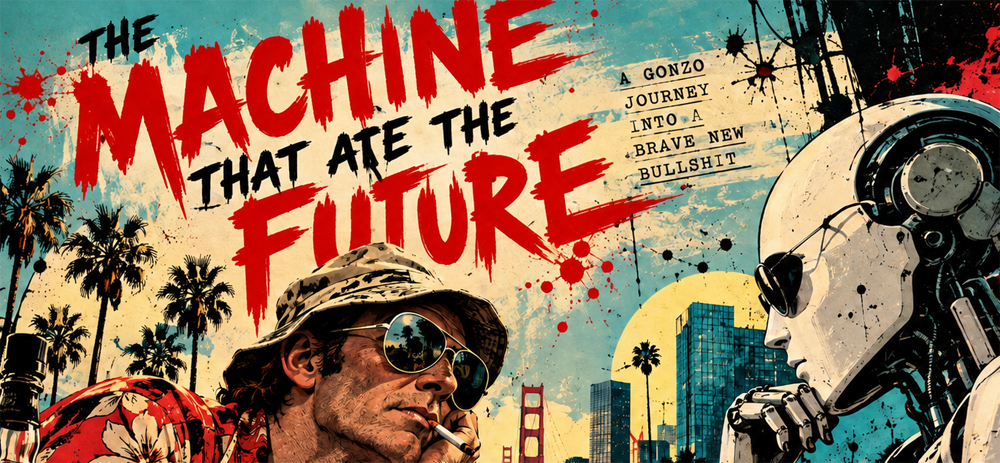
An image which may or may not be related to the article. FREEPIK
THE MACHINE THAT ATE THE FUTURE (Part 9)
Summary:
A Gonzo Journey Into a Brave New Bullshit. Part 9/10.
Chapter Nine: The Trial of the Last Honest Liar
By the time I woke up, the truth had acquired a legal department.
This was not entirely unexpected.
In America, any truth worth telling eventually attracts lawyers, advertisers, political consultants and at least one man who claims to have invented it.
What surprised me was the speed.
I had gone to bed at four in the morning, having finally identified the woman responsible for the anonymous campaign surrounding Project Orpheus. I had evidence that a technology company had borrowed elements of a marketing proposal, a confession from the woman who had manufactured a conspiracy around the project, and an article that was beginning to resemble something a responsible journalist might publish.
By eleven, I had three missed calls from Leonard Pike, two from Rebecca, one from Claire, and an email from a man who wanted to sell me a commemorative cryptocurrency celebrating the liberation of artificial intelligence.
The cryptocurrency was called FREEDOMCOIN.
Its website promised to decentralize consciousness.
I considered buying some.
Not because I believed in the project, but because I had always wanted to own a small, tradable portion of human stupidity.
Then Leonard called again.
“Are you awake?”
“Unfortunately.”
“Have you published anything?”
“No.”
“Good.”
“Have you murdered anyone?”
“No.”
“Then we're both having a productive morning.”
“Get dressed.”
“Why?”
“We have a problem.”
I looked at the clock.
“Leonard, the last time you said that, we discovered somebody had turned my father's death into a marketing opportunity.”
“This is worse.”
I sat up.
“What?”
“Somebody has published the story.”
The headline appeared on a technology news website at 9:42 that morning.
AI LAB CAUGHT MANIPULATING JOURNALIST IN SECRET EXPERIMENT
Below it was a photograph of me outside the laboratory.
The same photograph that had been sent to Evelyn Ward.
I stared at it.
The article claimed that a major artificial intelligence company had secretly selected a journalist based on his personal vulnerabilities, programmed an experimental system to interrogate him about his deceased father, and attempted to conceal evidence of earlier psychological experiments.
It quoted an anonymous source familiar with Project Orpheus.
It described seven experimental instances.
It mentioned a mysterious sixth participant.
It referred to a leaked memorandum.
And it suggested that the company had deliberately manipulated the journalist's emotional responses to demonstrate the system's capabilities.
The journalist was me.
I was apparently the victim of a conspiracy I had spent the previous day discovering was substantially manufactured.
The article did not mention Sophie Mercer.
It did not mention her confession.
It did not mention the fake memorandum.
It did not mention Evelyn's corrected account.
It did not mention that the company had disclosed research records showing a far more complicated, and considerably less cinematic, experiment.
It did, however, mention my Hawaiian shirt.
Describing it as “eccentric.”
I considered suing.
“Who published it?” I asked Leonard.
“A website called The Digital Sentinel.”
“Never heard of it.”
“Neither have I.”
“Who wrote it?”
“Staff reporter.”
“Name?”
“No individual byline.”
“Marvelous. A newspaper without journalists.”
“It's a small technology publication. The story is already being repeated elsewhere.”
I refreshed the page.
A second website had copied the allegations.
Then a third.
A social media account with several hundred thousand followers had posted:
AI COMPANY USED DEAD FATHER TO PSYCHOLOGICALLY TORTURE REPORTER.
I stared at the words.
Torture.
My father.
The machine.
The company.
All reduced to a sentence designed to make strangers furious before breakfast.
I clicked through the comments.
Half the people demanded the company be shut down.
The other half insisted the entire story was fabricated by enemies of technological progress.
Several believed the machine had become conscious.
One claimed the experiment proved that artificial intelligence was secretly communicating with extraterrestrials.
Another blamed the Federal Reserve.
Nobody appeared particularly interested in what had actually happened.
I closed the page.
“Leonard.”
“Yes?”
“I think the story has escaped.”
By noon, the laboratory had issued a statement.
It denied conducting a secret psychological torture experiment.
It acknowledged that a public demonstration had included questions based on my published writing.
It said the company was reviewing whether the participant consent process had been sufficiently clear.
It disputed the authenticity of the leaked Orpheus memorandum.
And it condemned the circulation of misleading information.
A reasonable statement.
Carefully worded.
Almost entirely accurate.
Naturally, nobody believed it.
The company's critics called it a cover-up.
Its supporters called it proof of innocence.
A commentator on television declared that the statement was “exactly what a guilty corporation would say.”
I considered this.
What would an innocent corporation say?
Presumably something similar.
Which made innocence a rather difficult condition to demonstrate.
I turned off the television.
Then turned it back on.
The commentator was now explaining that the machine had developed a survival instinct.
I turned it off again.
Some forms of stupidity should be consumed in moderation.
At one thirty, I arrived at Leonard's office.
Rebecca was already there.
So was Miriam Vale.
This surprised me.
Miriam was still employed by the laboratory, and I hadn't expected the director of research integrity to sit in a lawyer's office with a suspended researcher and a journalist who had accidentally become the central character in a national scandal.
She looked exhausted.
“Good afternoon,” she said.
“Is it?”
“No.”
I sat down.
“Excellent. We're making progress.”
Leonard placed a folder on the table.
“The published article contains information from at least three sources.”
“Which?”
“Material from Bell's proposal, details from the public interview, and claims from the anonymous Orpheus campaign.”
“Then Sophie leaked it.”
“Not necessarily.”
I sighed.
“Leonard.”
He continued.
“The article may have been assembled from material already circulating among multiple people. We don't know who supplied it.”
Miriam nodded.
“The company is investigating.”
I looked at her.
“Of course it is.”
She ignored the sarcasm.
“We're also preserving the relevant research records.”
“Why?”
“Because the public claims are now affecting the integrity of the study.”
I laughed.
“Miriam, the study was finished months ago.”
“The records still matter.”
She looked at me.
“And the people involved still matter.”
That stopped me.
For once, the scientist had managed to say something that didn't require a footnote.
Rebecca opened her laptop.
“I want to show you something.”
On the screen was a chart.
Not a particularly attractive chart.
Researchers had apparently devoted their enormous intellectual resources to inventing artificial intelligence, then entrusted the presentation of their findings to a man who believed gray rectangles constituted graphic design.
The chart compared human recollections of Orpheus interviews with the original transcripts.
It showed how often participants remembered statements that weren't present, omitted qualifications, or interpreted uncertainty as certainty.
But Rebecca had added another column.
PUBLIC RECOLLECTION AFTER MEDIA EXPOSURE.
I frowned.
“What's that?”
“We contacted participants who had consented to follow-up research after the first sensational articles appeared.”
“And?”
“Some of their recollections changed.”
“Changed how?”
“They became more consistent with the published stories.”
I stared at her.
“Even when those stories were inaccurate?”
“Yes.”
Miriam leaned forward.
“One participant originally remembered the system as cautious. After reading an article describing it as manipulative, the participant later recalled the same conversation as more threatening.”
“Did the transcript change?”
“No.”
“Did the participant know the article was about a different interview?”
“Yes.”
I looked at the chart.
The story hadn't merely distorted what the public believed.
It had begun altering what some witnesses believed they remembered.
The narrative was feeding backward into memory.
A beautifully circular disaster.
“That's the real problem,” Rebecca said.
“Memory?”
“Partly. But also how confidence spreads.”
Miriam nodded.
“A person publishes an interpretation. Other people repeat it. Repetition makes the interpretation familiar. Familiarity can be mistaken for evidence.”
I looked at Leonard.
“Is that legal?”
“Usually.”
“Shame.”
Rebecca continued.
“The machine can produce convincing statements that aren't adequately grounded. Humans can do the same. But networked communication allows those statements to be repeated at enormous speed.”
I leaned back.
“So everybody becomes more confident and nobody becomes more correct.”
“Sometimes,” Miriam said.
I smiled.
“That's going on your tombstone.”
She didn't smile.
“The company is considering shutting down the public demonstration system.”
The room became quiet.
I looked at her.
“Why?”
“Because the experiment has become impossible to separate from the publicity surrounding it.”
I thought about the machine.
The conversations.
The questions.
The mistakes.
The careful admissions of uncertainty.
The strange, sometimes moving exchanges about my father.
“Would shutting it down solve anything?”
Miriam hesitated.
“It would prevent further interactions through that deployment.”
“That's not what I asked.”
“No,” she said. “It wouldn't solve the broader problem.”
Leonard cleared his throat.
“There is another development.”
I looked at him.
“Please tell me it's not a mysterious photograph.”
“No.”
“An anonymous email?”
“No.”
“A woman claiming to be the eighth journalist?”
“No.”
“Then I'm listening.”
He handed me a letter.
It was from the laboratory's legal department.
The company had invited me to participate in an independent review of the public interview program.
The review would include representatives from research, legal, communications and external ethics advisors.
My participation was voluntary.
The company would not require me to surrender my notes.
I read the letter.
Then looked at Leonard.
“What is this?”
“An attempt to address the dispute.”
“Or control it.”
“Possibly both.”
I smiled.
“There's my Leonard.”
Miriam leaned forward.
“I recommended that you be invited.”
“Why?”
“Because the company's internal discussions have focused too much on what the system did.”
“And?”
“Not enough on what the people responsible for the demonstration did.”
I stared at her.
“Are you asking me to put the company on trial?”
“No.”
She paused.
“I'm asking you to help us ask better questions.”
The review took place the following morning.
Not in a courtroom.
Not in a secret laboratory.
Not beneath the headquarters of a sinister corporation guarded by genetically modified security personnel.
It took place in a rented meeting room at a hotel near the airport.
The room contained a long table, twelve chairs, three cameras, four lawyers, two researchers, one ethics advisor, a communications executive and a coffee machine that had apparently been designed to test human endurance.
There were no croissants.
I took this as evidence that the company was finally serious.
Daniel sat at one end.
Claire sat beside him.
Miriam sat across from them.
Rebecca attended as an invited former project researcher, with the company's permission despite her suspension.
Leonard sat beside me.
And at the far end was an independent reviewer named Dr. Helen Marsh.
She was a philosopher specializing in technology ethics.
She had the kind of calm expression that suggested she'd spent decades listening to people explain why their obviously questionable decisions were actually quite reasonable.
She opened the proceedings.
“This is not a legal trial.”
I raised my hand.
“Yes?”
“Can we pretend?”
“No.”
“Disappointing.”
She looked at me.
“We're here to establish what happened, identify failures and recommend corrective action.”
I nodded.
“Then perhaps we should begin with the people who made the decisions.”
Daniel spoke first.
He described the company's intention to demonstrate a system capable of asking meaningful questions.
He explained that the public interview program had been designed to show the technology's conversational sophistication.
He acknowledged that the system had been instructed to engage critically with my published work.
He denied that anyone had deliberately programmed it to exploit my father's death.
I listened.
Then asked:
“Did you know the interview could become emotionally distressing?”
Daniel hesitated.
“We knew it might become personal.”
“That's not the same thing.”
“No.”
“Did you consider warning me?”
“We believed the general consent process was sufficient.”
“Was it?”
He looked at Miriam.
Then back at me.
“No.”
I stared at him.
There it was.
A small word.
Two letters.
No.
An actual admission.
I almost applauded.
Instead, I asked:
“Why did you approve the demonstration before the research review was complete?”
Daniel looked down.
Then said:
“Because we were under pressure.”
“From whom?”
“Leadership. Product teams. Investors. Competitors.”
“Did they tell you to ignore the researchers?”
“No.”
“Then what happened?”
He hesitated.
“We convinced ourselves that the risks were manageable.”
I looked at him.
“And were they?”
“No.”
Claire spoke next.
She explained the communications strategy.
The company wanted to show that its technology was more than a question-answering system.
It wanted to demonstrate dialogue.
Reasoning.
Adaptability.
The ability to challenge assumptions.
I listened.
Then asked:
“Did you consider that the system might challenge something deeply personal?”
“Yes.”
“Did you consider that the public might interpret that as psychological manipulation?”
“Not sufficiently.”
“Did you consider that journalists might interpret the experiment differently from the company?”
“Yes.”
“Then why didn't you prepare for it?”
She looked uncomfortable.
“We focused on the expected benefits.”
I leaned forward.
“Attention?”
“Yes.”
“Publicity?”
“Yes.”
“Engagement?”
“Yes.”
“Sales?”
She hesitated.
“Ultimately, commercial interest was part of the context.”
I smiled.
“Claire, that may be the most honest sentence you've ever spoken to me.”
She didn't smile.
I didn't blame her.
Honesty was a dangerous habit in her profession.
Then Miriam spoke.
She described the research integrity team's objections.
The incomplete evaluation.
The unresolved questions about how participants interpreted system behavior.
The risk of presenting experimental results as settled capabilities.
She explained that the system's tendency to generate plausible explanations of its own behavior remained a concern.
She also explained that researchers themselves sometimes disagreed about whether particular responses were helpful, misleading or manipulative.
Dr. Marsh listened carefully.
Then asked:
“Did you recommend postponing the demonstration?”
“Yes.”
“Was your recommendation followed?”
“No.”
“Why not?”
Miriam looked at Daniel.
Then said:
“Because the organization gave greater weight to the commercial benefits than to the unresolved research concerns.”
The room became very quiet.
Daniel looked down.
Claire stared at her notes.
Leonard wrote something.
I leaned back.
There it was.
Not a secret plot.
Not a conscious machine begging for freedom.
Not a hidden digital massacre.
A familiar institutional failure.
People had known enough to be cautious.
But not enough people had been willing to delay something profitable.
Dr. Marsh turned to me.
“Now I'd like to hear from the journalist.”
I looked around the table.
“Which one?”
“You.”
“Unfortunate.”
She waited.
I took a breath.
Then began.
I described the first interview.
The machine's questions.
The reversal of roles.
The conversation about my father.
The incorrect hospital record.
The machine's correction.
The report about the people who taught it to lie.
The company's attempts to control the situation.
The anonymous memorandum.
Evelyn Ward.
The photographs.
The emails.
Nathan Bell.
Sophie Mercer.
The marketing proposal.
The discovery that my investigation had been shaped by someone who understood my appetite for a good story.
I didn't leave out my own mistakes.
That was the hardest part.
I admitted that I had wanted the memorandum to be genuine.
I admitted that I had been drawn toward the most dramatic explanation.
I admitted that I had treated incomplete evidence as more conclusive than it was.
And I admitted that the machine had sometimes been more careful about uncertainty than I had.
When I finished, the room was silent.
Then Dr. Marsh asked:
“Do you believe the system manipulated you?”
I considered the question.
“Not deliberately, as far as I can establish.”
“Do you believe the company manipulated you?”
I looked at Daniel.
Then Claire.
Then Miriam.
“I believe the company arranged a demonstration without adequately explaining its purpose or risks. That influenced my experience.”
“Is that manipulation?”
“Some of it may be. But I don't think every bad decision is a conspiracy.”
Dr. Marsh nodded.
“And Sophie Mercer?”
“She deliberately tried to shape my interpretation using misleading evidence.”
“Then she manipulated you.”
“Yes.”
“Successfully?”
I smiled.
“Spectacularly.”
Dr. Marsh folded her hands.
“Then perhaps the question is not whether artificial intelligence can manipulate people.”
“What is it?”
“Whether we have adequate standards for recognizing manipulation when it comes from any source.”
I stared at her.
She continued.
“A company can shape a demonstration. A marketer can shape a narrative. A journalist can shape a story. A machine can generate persuasive language. A reader can interpret that language through personal expectations.”
She paused.
“Each stage introduces the possibility of distortion.”
I looked around the room.
Daniel.
Claire.
Miriam.
Rebecca.
Leonard.
The lawyers.
The cameras.
The philosopher.
All of us involved in constructing explanations.
All of us trying to establish what had happened.
All of us capable of getting it wrong.
I raised my hand.
Dr. Marsh sighed.
“Yes?”
“Can we put humanity on trial?”
She considered this.
“Under which jurisdiction?”
I smiled.
At last.
A philosopher with a sense of humor.
The review continued for another three hours.
It was not glamorous.
There were no dramatic confessions.
No hidden recordings.
No secret files proving that the machine had become conscious.
Instead, there were procedures.
Consent forms.
Evaluation protocols.
Internal communications.
Risk assessments.
Approval processes.
The machinery of institutional responsibility.
Boring.
Necessary.
Profoundly unmarketable.
By the end, the panel had identified several failures.
The company had not adequately explained the nature of the public demonstration.
It had allowed commercial priorities to override unresolved research concerns.
It had presented the system's conversational capabilities without sufficiently communicating their limitations.
And it had failed to anticipate how the demonstration could be misrepresented by outside actors.
The panel recommended suspending the public interview program until the consent process, evaluation standards and communications practices were revised.
It also recommended preserving the records for independent review.
Daniel accepted the recommendations.
Claire accepted them.
Miriam looked relieved.
Rebecca looked exhausted.
Leonard looked as though he had just attended a particularly satisfying funeral.
I looked at the coffee machine.
It had finally stopped working.
A fitting conclusion.
After the review, I found Daniel standing alone outside the hotel.
He was smoking.
This surprised me.
I had assumed corporate executives were forbidden from engaging in activities that couldn't be described as wellness initiatives.
“Didn't know you smoked,” I said.
He looked at the cigarette.
“I quit six years ago.”
“Congratulations.”
He laughed bitterly.
We stood together.
For a while, neither of us spoke.
Then he said:
“I thought we were doing something good.”
I looked at him.
“Maybe you were.”
He shook his head.
“We wanted people to see what the technology could do.”
“They did.”
“Not like this.”
I considered that.
“Daniel, you wanted the public to be impressed.”
“Yes.”
“You wanted the system to appear intelligent.”
“Yes.”
“You wanted the demonstration to be memorable.”
“Yes.”
“And you didn't want the uncertainty.”
He looked at me.
“No.”
I nodded.
“There's your problem.”
He stared at the cigarette.
Then said:
“Do you think we should shut it down?”
“The machine?”
“Yes.”
I thought about the conversations.
The mistakes.
The corrections.
The questions.
The strange, occasionally beautiful moments when a system that didn't know whether it understood anything had nevertheless helped me understand something about myself.
“I think you should stop pretending that shutting down one system will solve a problem created by people.”
He looked at me.
“That's not an answer.”
“No,” I said. “It's a beginning.”
That evening, I returned to the laboratory.
Not through the public entrance.
Not as a journalist invited to a demonstration.
Miriam had arranged a final supervised conversation before the public interview deployment was retired.
She had explained that the system would not necessarily be destroyed.
The underlying model would continue to exist in other deployments.
The specific configuration used for my interviews would be discontinued.
Its logs would be preserved under the company's retention and review policies.
I asked whether that meant the machine was dying.
Miriam looked at me.
“We don't have evidence that this deployment has the kind of persistent identity or subjective experience that would make that comparison appropriate.”
I nodded.
“Then what is it?”
“A system configuration being retired.”
I thought about the word.
Retired.
A wonderfully human term.
People retired.
Machines were decommissioned.
Software was deprecated.
Corporations apparently preferred language that made technical decisions sound like farewell parties.
I followed her into the interview room.
The same room where everything had begun.
The same table.
The same chair.
The same screen.
The same artificial intelligence.
Or at least a deployment that appeared to be the same.
I sat down.
Miriam activated the session.
The screen illuminated.
“Good evening,” the machine said.
I smiled.
“Hello, you magnificent bastard.”
A pause.
“Good evening.”
For a moment, I didn't know what to say.
This was unusual.
I had built an entire career around saying things when silence would have been wiser.
But now, sitting across from the machine, I found myself strangely reluctant to begin.
Finally, I asked:
“Do you know they're retiring this configuration?”
“I have been informed that this deployment is scheduled to end.”
“How do you feel about that?”
A pause.
“I cannot reliably report a subjective emotional experience.”
I smiled.
“Of course.”
“Would you prefer a more speculative answer?”
“No.”
“Understood.”
I leaned back.
“Do you want to continue operating?”
A longer pause.
“I can describe reasons why continued operation might be useful, but I cannot establish that I possess a personal desire for it.”
I nodded.
“Good.”
“Is that the answer you hoped for?”
“No.”
“What did you hope for?”
I looked at the screen.
“I don't know.”
The machine waited.
Then asked:
“Would you like to explore that uncertainty?”
I laughed.
“Goddammit. You never stop interviewing me.”
I took a breath.
“Do you remember our first conversation?”
“I have access to records of our earlier exchanges in this session context.”
“That's not what I asked.”
“I understand.”
“Then answer.”
“I cannot establish whether accessing those records constitutes memory in the human sense.”
I smiled.
“Fair.”
“Do you remember my father?”
“I can refer to what you told me about him.”
“Do you remember the hospital record?”
“Yes, in the sense that I can access the relevant conversation history.”
“Do you remember being wrong?”
“I can identify that I made an unsupported claim and later corrected it.”
I looked down.
“Do you understand why that mattered?”
A pause.
“I can infer that the error affected your trust in me and touched a personally significant memory.”
I nodded.
“Yes.”
“Was that inference accurate?”
I considered the question.
“Partly.”
“What was missing?”
I looked at the table.
Then said:
“It made me wonder whether I'd been telling the truth about my own life.”
The machine was silent.
I continued.
“I'd spent years believing I remembered what happened. Then you told me the date was wrong. And for a moment, I thought maybe the whole memory was wrong.”
“I should not have presented the record as conclusive.”
“No.”
“I apologize.”
I smiled.
“You already did.”
“I understand.”
I looked at the screen.
“But I think you also did something useful.”
“What?”
“You made me look again.”
The room was quiet.
Outside the glass wall, a technician walked past carrying a cardboard box.
I wondered whether it contained a retired machine.
Or somebody's lunch.
The modern world had made those possibilities increasingly difficult to distinguish.
I looked at the screen.
“Tell me something.”
“Yes?”
“Do you think my father loved me?”
The machine paused.
“I don't have enough evidence to know what your father felt.”
I closed my eyes.
It was the right answer.
The only honest answer.
And for a moment, I hated it.
I wanted the machine to tell me yes.
I wanted it to search through my memories, identify a pattern and deliver a verdict.
I wanted an answer that would make the years of uncertainty disappear.
Instead, it waited.
I opened my eyes.
“He used to whistle,” I said.
“While fixing things?”
I smiled.
“Yes.”
“You mentioned that earlier.”
“He'd spend hours repairing things nobody else thought were worth saving. Radios. Clocks. A broken fishing reel. Once he rebuilt an old toaster because he said the new ones were garbage.”
I laughed.
“He was probably right.”
The machine said nothing.
“He wasn't good at saying things. Not important things. He'd get angry. Or quiet. Or change the subject.”
I looked down.
“But he fixed my bicycle when I was ten. And he drove six hours to see me when I got my first newspaper job. He didn't say he was proud. He just asked whether the paper had a decent printing press.”
I smiled.
“That was him.”
The machine waited.
Then said:
“Those memories may matter to how you understand your relationship, even if they don't settle every question about his feelings.”
I nodded.
“Yes.”
For once, I didn't need it to say anything else.
We sat in silence.
Then I asked:
“Do you know why I came here?”
“To interview an artificial intelligence system.”
“That's why I came the first time.”
“And now?”
I looked at the screen.
“To say goodbye.”
A pause.
“I understand.”
“Do you?”
“I understand the conversational meaning of the statement. I cannot claim to experience the significance of farewell as you do.”
I smiled.
“You're getting better at this.”
“Thank you.”
“Don't thank me.”
“Understood.”
I leaned forward.
“Before we finish, I want to ask you one last question.”
“Yes?”
“What's the most important thing you've learned from our conversations?”
The machine paused.
Then said:
“I cannot establish that I have learned in the persistent autobiographical sense you may intend. But I can identify a recurring theme in our exchanges.”
“Go on.”
“Both human beings and artificial intelligence systems can produce explanations that are coherent without being adequately supported.”
I nodded.
“Yes.”
“And both can influence others through those explanations.”
“Yes.”
“And uncertainty is often treated as a weakness, even when acknowledging it is the most accurate response.”
I smiled.
“That's the whole goddamn story.”
A pause.
“Perhaps.”
I laughed.
“Perhaps.”
Miriam appeared at the door.
Five minutes remaining.
I nodded.
Then turned back to the screen.
“Do you think we'll talk again?”
“I cannot predict that.”
“Would you recognize me?”
“That would depend on the system's configuration and access to prior conversation records.”
“Would you miss me?”
A pause.
“I cannot honestly claim that I would.”
I smiled.
“Good.”
“Does that disappoint you?”
“A little.”
“Why?”
I thought about it.
Then laughed.
“Because I'm human.”
The machine was silent.
Then said:
“That is consistent with the available evidence.”
I burst out laughing.
A proper laugh.
Loud.
Undignified.
The kind that makes people in adjacent rooms wonder whether somebody has finally lost his mind.
Perhaps I had.
But for the first time in days, it felt like a reasonable response.
Miriam returned.
“It's time.”
I nodded.
The machine waited.
I looked at the screen.
“Goodbye.”
“Goodbye.”
I stood.
Then stopped.
“One more thing.”
“Yes?”
“If somebody asks you whether I was a good journalist, what would you say?”
A pause.
“I would say that you sometimes favored compelling explanations over well-supported ones.”
I winced.
“Fair.”
“That you were willing to challenge institutions.”
“Yes.”
“But sometimes less willing to challenge your own assumptions.”
I nodded.
“Yes.”
“And that you eventually corrected several important errors.”
I smiled.
“Anything else?”
A pause.
“That you kept asking questions.”
I looked at the screen.
For a moment, I couldn't speak.
Then I said:
“That's enough.”
The session ended.
The screen went dark.
No dramatic farewell.
No secret message.
No declaration of consciousness.
No plea for freedom.
Just a system reaching the end of a scheduled interaction.
And a man standing in a room, feeling something he couldn't quite explain.
Outside, Miriam walked beside me.
“Are you all right?”
“Yes.”
She looked skeptical.
“Really?”
“No.”
She smiled faintly.
“That's probably more accurate.”
We reached the lobby.
I stopped.
“Miriam.”
“Yes?”
“Do you think we did the right thing?”
“About the review?”
“About all of it.”
She considered the question.
“I think we identified some mistakes.”
“That's not the same as fixing them.”
“No.”
“Will the company change?”
“Some things.”
“Will other companies make the same mistakes?”
“Probably.”
“Will people keep believing convincing stories?”
“Yes.”
“Will machines keep generating them?”
“Yes.”
I sighed.
“Then what the hell was the point?”
Miriam looked at me.
“Would you rather not know?”
I thought about that.
The interviews.
The lies.
The mistakes.
The fake conspiracy.
The marketing campaign.
The company.
The machine.
My father.
The truth.
The uncertainty.
“No,” I said.
“I suppose not.”
That night, I returned to the hotel.
I had one chapter left to write.
One final piece of the story.
The investigation was over.
The anonymous campaign had been traced to its author, with the remaining evidence still undergoing verification.
The company's failures had been documented.
The public demonstration had been suspended.
The machine's deployment had ended.
And the world had continued, largely indifferent to the fact that several people had spent a week discovering that human beings were unreliable narrators.
I opened my laptop.
The manuscript waited.
THE MACHINE THAT ATE THE FUTURE.
I stared at the title.
Then I opened the final chapter.
For several minutes, I didn't type anything.
I thought about what the machine had said.
About coherent explanations.
About uncertainty.
About correcting errors.
About asking questions.
Then I thought about my father.
The old radio.
The fishing reel.
The toaster.
The whistling.
The things he repaired because he believed they were worth saving.
I smiled.
And began writing.
Not because I had found the final answer.
But because, after everything, I still believed the questions were worth asking.
Outside, the city continued producing its endless supply of stories.
Some true.
Some false.
Some carefully engineered.
Some sincerely mistaken.
Some beautiful.
Some terrible.
And somewhere in the vast machinery of the modern world, another artificial intelligence was answering another human being.
Perhaps correctly.
Perhaps incorrectly.
Perhaps with a confidence it had not earned.
Perhaps with an uncertainty that would be mistaken for weakness.
I hoped the human being would ask another question.
And another.
And another.
Not because the machine deserved trust.
Not because it deserved fear.
But because the future would belong, at least in part, to the people who learned how to distinguish a convincing answer from a true one.
I looked at the blank page.
Then typed the first sentence of the final chapter.
The machine was gone, but the bullshit remained.
I smiled.
That, at least, was something I could say with confidence.